
Walk on terrain
- Keyboard
- Mouse
- Gamepad
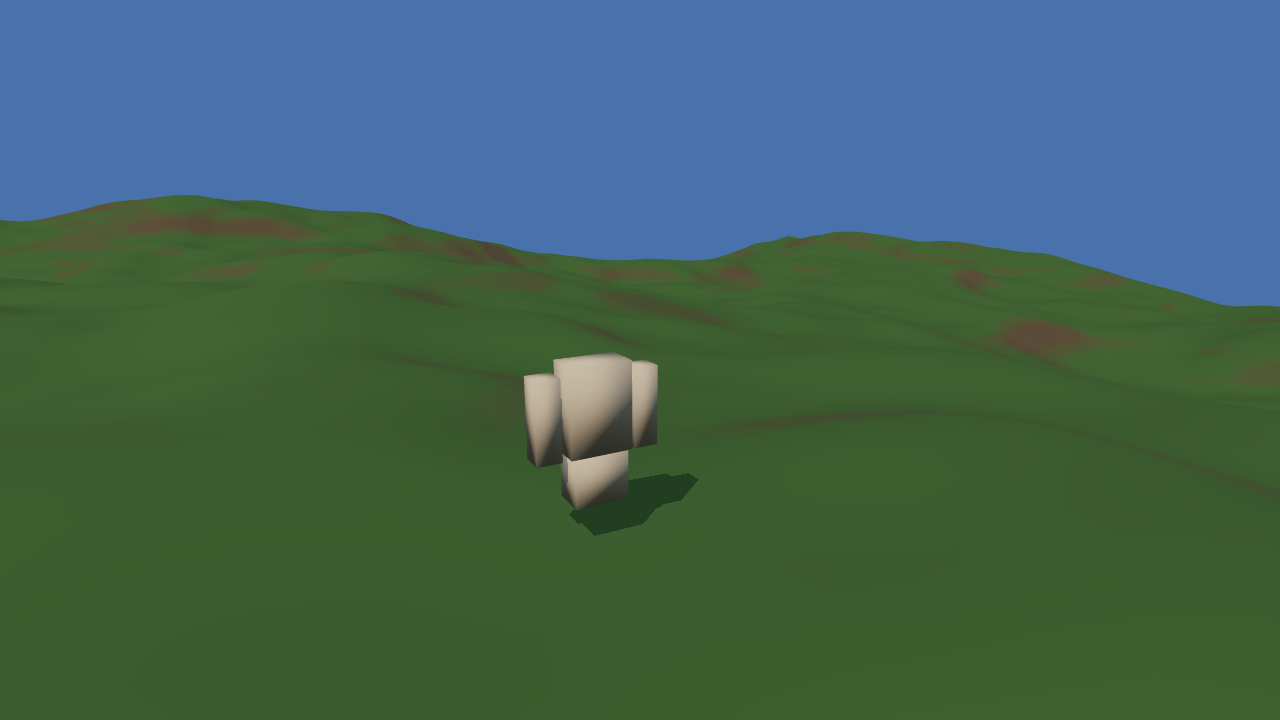
`@ignifx/terrain` does not import `@ignifx/physics`, so a terrain in a game with no physics costs no physics code. The join is data: `terrain.colliderInit()` answers the exact fields a `HeightfieldCollider` declares — a row-major heights array, its sample counts, the size in metres, and the centre that offsets the shape onto the field — so handing it straight to `addComponent` is the entire integration, and re-reading it inside `onHeightsChanged` is how a sculpted terrain stays solid. The readouts under it come from the height field rather than from the collider, which is why `heightAt` and `slopeAt` answer whether or not physics is running. The dust is a `ParticleSystem` that never plays: a script counts stride length and calls `emit()`, and emission runs late in `Update` so a burst asked for this frame is drawn this frame.
WebGPU: checking…See browser support
Try this
- Walk up the steepest face you can find. The controller gives up at its `slopeLimit`, not at the collider's.
- Sprint across the flat: the puffs stay the same distance apart, because the stride is metres and not seconds.
- Watch “Collider samples”: the whole 257-square field is one static Havok heightfield, built once.
Show source code
Source
import { Camera, CharacterController, Environment, HeightfieldCollider, Light, MODEL_ASSET_TYPE, Model, particleAssetFromDefinition, particleDefinition, particles, ParticleSystem, physics, Terrain, terrain, terrainAssetFromDefinition, ThirdPersonCamera, ThirdPersonController, threeD,} from "ignifx";import { bootExample } from "../_kit/boot.ts";import { bind, readout, slider, toggle } from "../_kit/panel.ts";import { DragToLook, PLAYER_ACTIONS } from "./controls.ts";import { Footsteps } from "./footsteps.ts";import type { ModelAsset } from "ignifx";/** * A character walking on a terrain, and the one line that makes the ground solid. * * ## Physics by data, not by dependency * * `@ignifx/terrain` does not import `@ignifx/physics`: a terrain in a game with no physics costs no * physics code. The join is `terrain.colliderInit()`, which answers the exact fields a * `HeightfieldCollider` declares — a row-major `heights` array, its sample counts, the size in * metres, and the `center` that offsets the shape onto the field. Passing it straight into * `addComponent` is the whole integration, and re-reading it inside `onHeightsChanged` is how a * sculpted terrain stays solid. * * ## What the terrain answers without a collider * * `heightAt` and `slopeAt` read the height field itself, so the readouts below work whether or not * physics is running — which is the point of keeping queries out of the collider. * * ## The dust * * `footsteps.ts` counts stride length and calls `ParticleSystem.emit()`. Emission runs late in * `Update`, after every script, so a burst asked for this frame is uploaded and drawn this frame. *//** The repository's own rigged "box-man". */const RIG_ADDRESS = "models/rig.glb";/** Where Havok's WebAssembly is served from; an extension's public asset is copied unhashed. */const HAVOK_WASM_URL = `${import.meta.env.BASE_URL}assets/HavokPhysics.wasm`;/** The sky the hills stand against. */const SKY = { r: 0.57, g: 0.7, b: 0.84, a: 1 } as const;/** The character capsule's height, in metres. The rig is about 1.45 m tall. */const CAPSULE_HEIGHT = 1.6;/** Where the character starts, in metres along X and Z; Y comes from the height field. */const SPAWN = { x: -6, z: -14 } as const;/** * Writes a metre count. * * @param value - Metres. * @returns The text for the value cell. */function metres(value: number): string { return `${value.toFixed(1)} m`;}bootExample({ title: "Walk on terrain", // `threeD()` requires `physics()` and `input()` before it; the kit registers `input()` first. extensions: [physics(), threeD(), terrain(), particles()], settings: { rendering: { clearColor: SKY, msaaSamples: 4, features: { shadows: true } }, time: { fixedDeltaTime: 1 / 60 }, physics: { havokWasm: HAVOK_WASM_URL }, }, async setup({ app, panel, afterStart }) { app.registerComponents([DragToLook, Footsteps]); app.input.loadActions(PLAYER_ACTIONS); const hills = await terrainAssetFromDefinition(app, { name: "hills", size: { width: 128, depth: 128, height: 13 }, resolution: 257, chunks: { size: 32, lodLevels: 3, lodDistance: 48, skirtDepth: 1 }, noise: { seed: 21, octaves: 5, frequency: 0.02, persistence: 0.45 }, layers: [ { name: "grass", color: [0.33, 0.45, 0.23] }, { name: "dirt", color: [0.44, 0.36, 0.26] }, { name: "rock", color: [0.45, 0.44, 0.42] }, ], splatRules: [ { layer: "grass", slope: [0, 22] }, { layer: "dirt", slope: [16, 34] }, { layer: "rock", slope: [30, 90] }, ], material: { roughness: 0.95, metallic: 0 }, }); const rig = app.assets.load<ModelAsset>(RIG_ADDRESS, { type: MODEL_ASSET_TYPE }); await rig.promise; // Placed above the ground rather than at the origin: a directional shadow map is fitted around // the light's own node, so a sun sitting inside the terrain casts nothing onto it. const sun = app.world.createEntity("Sun", { position: { x: -26, y: 40, z: -22 } }); sun.transform.lookAt({ x: 0, y: 0, z: 0 }); const key = sun.addComponent(Light, { type: "directional", intensity: 3, color: { r: 1, g: 0.97, b: 0.91, a: 1 } }); key.shadows.enabled = true; key.shadows.mapSize = 2048; key.shadows.maxDistance = 60; key.shadows.darkness = 0.32; key.shadows.normalBias = 0.02; app.world.createEntity("Sky light").addComponent(Light, { type: "hemispheric", intensity: 0.9, color: SKY, groundColor: { r: 0.28, g: 0.3, b: 0.22, a: 1 }, }); const sky = app.world.createEntity("Environment").addComponent(Environment, { clearColor: SKY }); sky.imageProcessing.toneMapping = "aces"; const groundEntity = app.world.createEntity("Hills"); const ground = groundEntity.addComponent(Terrain, { definition: hills }); // The whole physics integration: the terrain answers in the shape the collider declares, and // an entity with a collider and no `Rigidbody` gets an implicit static body. const collider = groundEntity.addComponent(HeightfieldCollider, ground.colliderInit()); const spawnY = hills.value.field.heightAt(SPAWN.x, SPAWN.z) + CAPSULE_HEIGHT / 2 + 0.02; const character = app.world.createEntity("Walker", { position: { x: SPAWN.x, y: spawnY, z: SPAWN.z } }); character.addComponent(CharacterController, { height: CAPSULE_HEIGHT, radius: 0.32, slopeLimit: 48 }); const controller = character.addComponent(ThirdPersonController, { walkSpeed: 3.4, sprintSpeed: 6.6, jumpHeight: 1.1, stepHeight: 0.35, rotateToMovement: true, }); character.addComponent(DragToLook); // The model hangs off a child: a `CharacterController`'s capsule is centred on its own entity // and the rig's origin is between its feet. const body = app.world.createEntity("Walker Body", { parent: character }); body.transform.localPosition.set(0, -CAPSULE_HEIGHT / 2, 0); body.addComponent(Model, { model: rig.retain(), castShadows: true, receiveShadows: true }); const dustEntity = app.world.createEntity("Footstep dust", { parent: character }); dustEntity.transform.localPosition.set(0, -CAPSULE_HEIGHT / 2 + 0.05, 0); const dust = dustEntity.addComponent(ParticleSystem, { definition: particleAssetFromDefinition(app, particleDefinition("dust"), "fx/footstep-dust"), playOnAwake: false, seed: 5, }); const steps = character.addComponent(Footsteps); steps.controller = controller; steps.dust = dust; const eye = app.world.createEntity("Main Camera"); eye.addComponent(Camera, { near: 0.1, far: 400, fov: 56 }); eye.transform.localEulerAngles = { x: 16, y: 28, z: 0 }; const boom = eye.addComponent(ThirdPersonCamera, { target: character, distance: 5.2, shoulderOffset: { x: 0.4, y: 0.6, z: 0 }, damping: 0.07, minPitch: -12, maxPitch: 55, sensitivity: 0.2, // Nothing to sweep against: the terrain's chunks are renderables, not physics bodies, and the // only collider in the world is the ground the camera is already above. collisionEnabled: false, }); afterStart((): void => { boom.snap(); }); panel({ title: "Walk on terrain", groups: [ { label: "Character", controls: [ slider( "Walk", { min: 1, max: 7, step: 0.1, format: (v): string => `${v.toFixed(1)} m/s` }, bind(controller, "walkSpeed"), ), slider("Jump", { min: 0.2, max: 2.5, step: 0.05, format: metres }, bind(controller, "jumpHeight")), readout("Speed", (): string => `${controller.speed.toFixed(1)} m/s`), readout("Grounded", (): string => (controller.isGrounded ? "yes" : "no")), ], }, { label: "The ground under it", controls: [ readout("Terrain height", (): string => metres(ground.heightAt(character.transform.position.x, character.transform.position.z)), ), readout( "Slope", (): string => `${ground.slopeAt(character.transform.position.x, character.transform.position.z).toFixed(0)}°`, ), readout("Collider samples", (): string => `${String(collider.samplesX)} x ${String(collider.samplesZ)}`), ], }, { label: "Dust", controls: [ toggle("Footstep dust", bind(steps, "dustEnabled")), slider("Stride", { min: 0.6, max: 4, step: 0.1, format: metres }, bind(steps, "strideLength")), readout("Particles alive", (): string => String(dust.aliveCount)), ], }, ], }); },});/** * The walker's input: one action map, and the gate that arms the mouse look only while the pointer * is down. * * `ThirdPersonController` reads `Move`, `Jump` and `Sprint` and `ThirdPersonCamera` reads `Look`, * all four by **name**, so an example only has to declare a map that carries them. A page cannot * lock the pointer the way a full-screen game does — the visitor has to be able to reach the * parameter panel — so `Look` is bound to `<Pointer>/delta` and switched off unless the pointer is * down or a stick is pushed. */import { defineInputActions, Script } from "ignifx";import type { InputActionsDefinition, ScriptCallbacks } from "ignifx";/** Below this magnitude a stick counts as centred, and the mouse look stays switched off. */const STICK_EPSILON = 0.001;/** The actions the character and its camera read. */export const PLAYER_ACTIONS: InputActionsDefinition = defineInputActions({ maps: [ { name: "Player", actions: [ { name: "Move", type: "vector2", bindings: [ { composite: "2DVector", up: "<Keyboard>/w", down: "<Keyboard>/s", left: "<Keyboard>/a", right: "<Keyboard>/d", }, { composite: "2DVector", up: "<Keyboard>/arrowUp", down: "<Keyboard>/arrowDown", left: "<Keyboard>/arrowLeft", right: "<Keyboard>/arrowRight", }, { path: "<Gamepad>/leftStick", processors: ["deadzone(0.2)"] }, { path: "<Gamepad>/dpad" }, ], }, { name: "Look", type: "vector2", bindings: [{ path: "<Pointer>/delta" }, { path: "<Gamepad>/rightStick", processors: ["deadzone(0.2)"] }], }, { name: "LookStick", type: "vector2", bindings: [{ path: "<Gamepad>/rightStick", processors: ["deadzone(0.2)"] }], }, { name: "Drag", bindings: [{ path: "<Pointer>/press" }] }, { name: "Jump", bindings: [{ path: "<Keyboard>/space" }, { path: "<Gamepad>/buttonSouth" }] }, { name: "Sprint", bindings: [{ path: "<Keyboard>/shiftLeft" }, { path: "<Gamepad>/leftStickPress" }] }, ], }, ],});/** * Arms the `Look` action only while the pointer is down or a stick is pushed. * * @remarks * A pointer action is masked for the frame while the UI overlay holds the pointer, so `Drag` reads * as released while a slider is being dragged — which is why dragging one never also turns the * camera. */export class DragToLook extends Script implements ScriptCallbacks { /** The namespaced registration id. */ static typeId = "terrain-walk/DragToLook"; /** Switches `Look` on and off for the frame. */ update(): void { const look = this.app.input.actions.find("Look"); if (look === null) { return; } const held = this.app.input.actions.find("Drag")?.isPressed ?? false; const stick = this.app.input.actions.find("LookStick")?.vector; const pushed = stick !== undefined && Math.hypot(stick.x, stick.y) > STICK_EPSILON; look.enabled = held || pushed; }}/** * Dust under the walker's feet: one `ParticleSystem` that never plays, and a script that calls * `emit()` once per stride. * * `emit(count)` spawns at the system's current clock whether the system is playing or not, and the * emission phase runs late in `Update`, after every script, so a burst asked for this frame is * uploaded and drawn this frame. Stride length rather than a timer is what makes the puffs line up * with the ground: a sprinting character leaves them the same distance apart as a walking one. */import { Script } from "ignifx";import type { ParticleSystem, ScriptCallbacks, ThirdPersonController } from "ignifx";/** Below this speed, in metres per second, the character is not walking and leaves no dust. */const WALK_THRESHOLD = 0.6;/** How many particles one footfall throws up. */const PARTICLES_PER_STEP = 5;/** * Emits a puff of dust every stride while the character is on the ground. * * @example * ```ts * const steps = character.addComponent(Footsteps); * steps.controller = controller; * steps.dust = dust; * ``` */export class Footsteps extends Script implements ScriptCallbacks { /** The namespaced registration id. */ static typeId = "terrain-walk/Footsteps"; /** The controller whose speed and grounding decide when a step lands. Assigned in code. */ controller: ThirdPersonController | null = null; /** The effect the steps emit into. Assigned in code. */ dust: ParticleSystem | null = null; /** Metres between puffs. */ strideLength = 1.6; /** Whether the dust is switched on at all; the panel writes it. */ dustEnabled = true; /** How far the character has walked since the last puff, in metres. */ #travelled = 0; /** * Counts distance walked and emits when a stride is complete. * * @param dt - Seconds since the previous frame. */ update(dt: number): void { const controller = this.controller; const dust = this.dust; if (controller === null || dust === null) { return; } if (!controller.isGrounded || controller.speed < WALK_THRESHOLD) { this.#travelled = 0; return; } this.#travelled += controller.speed * dt; if (this.#travelled < this.strideLength) { return; } this.#travelled = 0; if (this.dustEnabled) { dust.emit(PARTICLES_PER_STEP); } }}