
Procedural terrain
- Mouse
- Touch
- Gamepad
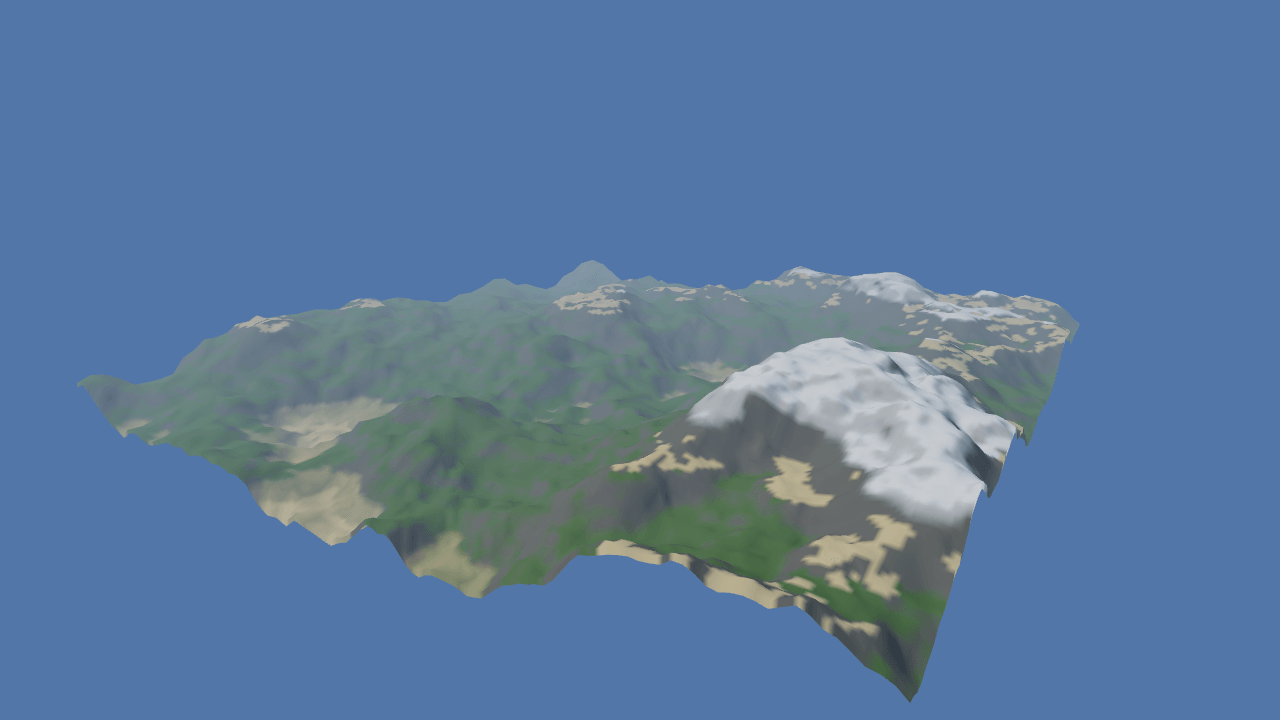
No heightmap and no file. `terrainAssetFromDefinition` builds the whole asset in memory from the object literal in `recipe.ts` plus whatever the sliders have done to it, so every control on the right rebuilds the field, the chunks and the splat together. The noise is fractional Brownian motion: `octaves` layers, each twice as fine and `persistence` times quieter; `ridged` folds every layer around its midpoint, which turns dunes into crests; `terraces` quantises the result into steps. The paint is rules rather than an image — a layer claims a height band, a slope band or both, and the generator feathers each edge by a tenth of its width — which is why a new seed is a new island and not old paint on a new hill.
WebGPU: checking…See browser support
Try this
- Press “New island” a few times. The build time under it is the whole cost: field, chunks and splat.
- Turn Ridged on with octaves at 6. The same seed becomes mountains, and the rock rule finds the new slopes.
- Pull Terraces up to 12. Every rule still applies — the snow line now follows the steps.
Show source code
Source
import { Camera, Terrain, terrain, terrainAssetFromDefinition } from "ignifx";import { bootExample } from "../_kit/boot.ts";import { attachOrbit } from "../_kit/orbit.ts";import { button, readout, slider, toggle } from "../_kit/panel.ts";import { createSky, FIELD, LAYERS, SHOT, SKY, SPLAT_RULES } from "./recipe.ts";import type { App, AssetHandle, TerrainAsset, TerrainDefinitionInput } from "ignifx";/** * The same terrain system with no heightmap at all: seven numbers and a seed. * * `terrainAssetFromDefinition` builds a `TerrainAsset` in memory — no file, no fetch — so the whole * document is the object literal in `recipe.ts` plus whatever the sliders have done to it. The * noise is fractional Brownian motion: `octaves` layers of it, each `lacunarity` times finer and * `persistence` times quieter. `ridged` folds each layer around its midpoint, which turns rolling * dunes into crests, and `terraces` quantises the result into steps. * * The splat here is **rules**, not a painted map: each rule claims a layer inside a height band, a * slope band, or both, and the generator feathers every band's edge by a tenth of its width so the * layers blend. That is the half of the terrain that regenerates with the shape, and it is why a * new seed is a new island rather than an old paint job on a new hill. * * ## Why the old asset is released a beat late * * Assigning `ground.definition` does not rebuild the chunks; `TerrainLodSystem` does, in the next * `PreRender`. Releasing the outgoing asset in the same statement would dispose the control-map * textures the chunks are still bound to, so the handle is kept until the regeneration **after** * the one that replaced it. *//** * The knobs the panel writes, which are the noise half of the document. * * @remarks * Plain mutable numbers rather than a component's fields, because there is no terrain component to * hold them: the document is rebuilt from scratch on every change. */interface Recipe { seed: number; octaves: number; frequency: number; persistence: number; ridged: boolean; terraces: number;}bootExample({ title: "Procedural terrain", extensions: [terrain()], settings: { rendering: { clearColor: SKY, msaaSamples: 4, features: { shadows: false } }, time: { fixedDeltaTime: 1 / 60 }, }, async setup({ app, panel }) { const recipe: Recipe = { seed: 7, octaves: 6, frequency: 0.009, persistence: 0.5, ridged: false, terraces: 0 }; let buildMs = 0; /** * The whole document for the current recipe. * * @returns What `terrainAssetFromDefinition` takes. */ function definition(): TerrainDefinitionInput { return { name: "procedural", size: FIELD.size, resolution: FIELD.resolution, chunks: FIELD.chunks, noise: { ...recipe, lacunarity: 2 }, layers: LAYERS, splatRules: SPLAT_RULES, material: { roughness: 0.95, metallic: 0 }, }; } /** * Builds one terrain asset and records how long it took. * * @param host - The app whose asset service registers it. * @returns The handle, with one holder — this file. */ async function build(host: App): Promise<AssetHandle<TerrainAsset>> { const started = performance.now(); const asset = await terrainAssetFromDefinition(host, definition()); buildMs = performance.now() - started; return asset; } const first = await build(app); const sky = createSky(app); const ground = app.world.createEntity("Terrain").addComponent(Terrain, { definition: first }); const eye = app.world.createEntity("Main Camera"); eye.addComponent(Camera, { near: 1, far: 1400, fov: 52 }); attachOrbit(app, eye, { yaw: SHOT.yaw, pitch: SHOT.pitch, distance: SHOT.distance, target: SHOT.target, minDistance: 40, maxDistance: 620, idleDegreesPerSecond: 3, }); let held: AssetHandle<TerrainAsset> | null = null; let rebuilding = false; let again = false; /** * Replaces the terrain with one built from the current recipe. * * @remarks * One build at a time, with a trailing one: a dragged slider fires on every step, and what has * to land is the value the visitor stopped on. */ function regenerate(): void { if (rebuilding) { again = true; return; } rebuilding = true; again = false; void build(app) .then((next: AssetHandle<TerrainAsset>): void => { const previous = ground.definition; ground.definition = next; held?.release(); held = previous; rebuilding = false; if (again) { regenerate(); } }) .catch((error: unknown): void => { rebuilding = false; app.log.warn("terrain regeneration failed:", error); }); } panel({ title: "Procedural terrain", groups: [ { label: "Noise", controls: [ slider( "Seed", { min: 1, max: 60, step: 1 }, { value: recipe.seed, change: (value: number): void => { recipe.seed = Math.round(value); regenerate(); }, }, ), slider( "Octaves", { min: 1, max: 8, step: 1 }, { value: recipe.octaves, change: (value: number): void => { recipe.octaves = Math.round(value); regenerate(); }, }, ), slider( "Frequency", { min: 0.002, max: 0.03, step: 0.001, format: (v): string => v.toFixed(3) }, { value: recipe.frequency, change: (value: number): void => { recipe.frequency = value; regenerate(); }, }, ), slider( "Persistence", { min: 0.25, max: 0.75, step: 0.01 }, { value: recipe.persistence, change: (value: number): void => { recipe.persistence = value; regenerate(); }, }, ), ], }, { label: "Shape", controls: [ toggle("Ridged", { value: recipe.ridged, change: (on: boolean): void => { recipe.ridged = on; regenerate(); }, }), slider( "Terraces", { min: 0, max: 24, step: 1, format: (v): string => (v === 0 ? "off" : v.toFixed(0)) }, { value: recipe.terraces, change: (value: number): void => { recipe.terraces = Math.round(value); regenerate(); }, }, ), button("New island", (): void => { recipe.seed = (recipe.seed % 60) + 1; regenerate(); }), ], }, { label: "Air", collapsed: true, controls: [ slider( "Fog density", { min: 0, max: 0.004, step: 0.0001, format: (v): string => v.toFixed(4) }, { value: sky.fog.density, change: (value: number): void => { sky.fog.density = value; }, }, ), readout("Build time", (): string => `${buildMs.toFixed(0)} ms`), readout("Chunks drawn", (): string => `${String(ground.visibleChunks)} of ${String(ground.chunkCount)}`), // `Terrain.drawCalls`, because a chunk is a renderable and not a component: Lite's own // counter includes bindings the terrain never issued. readout("Terrain draws", (): string => String(ground.drawCalls)), ], }, ], }); },});/** * The parts of the procedural terrain the panel never changes: its extent, its chunking, its four * tinted layers, the rules that paint them, and the shot. * * The layers carry a `color` and no `albedo`, which is the one thing a terrain built in code cannot * have: assembling a texture array needs decoded images, and only the `.terrain.json` loader * fetches those. A tinted terrain is the right trade here — every slider rebuilds the whole asset, * and rebuilding four texture arrays each time would be the slowest thing on screen. */import { Environment, Light } from "ignifx";import type { App, TerrainChunksDefinition, TerrainLayerInput, TerrainSize, TerrainSplatRuleInput } from "ignifx";/** The field: 384 m across, 257 samples a side, eight chunks each way. */export const FIELD: { readonly size: TerrainSize; readonly resolution: number; readonly chunks: TerrainChunksDefinition;} = { size: { width: 384, depth: 384, height: 62 }, // 2^8 + 1. Small enough that a rebuild is a few tens of milliseconds, which is what makes a // slider feel like a slider rather than a button. resolution: 257, chunks: { size: 32, lodLevels: 4, lodDistance: 110, skirtDepth: 2 },};/** The four layers, bottom to top. Order is channel order in the generated control map. */export const LAYERS: readonly TerrainLayerInput[] = [ { name: "sand", color: [0.82, 0.74, 0.55] }, { name: "grass", color: [0.33, 0.46, 0.22] }, { name: "rock", color: [0.42, 0.41, 0.39] }, { name: "snow", color: [0.92, 0.94, 0.97] },];/** * Where each layer appears. * * @remarks * A rule claims a height band, a slope band, or both; the generator feathers every edge by a tenth * of the band's width, so the layers blend instead of stepping. A texel no rule reaches falls to * the first layer, which is why `sand` names no band at all. */export const SPLAT_RULES: readonly TerrainSplatRuleInput[] = [ { layer: "sand", height: [0, 9] }, { layer: "grass", height: [5, 34], slope: [0, 34] }, { layer: "rock", slope: [28, 90] }, { layer: "snow", height: [46, 62], slope: [0, 44] },];/** The sky the field stands against. */export const SKY = { r: 0.6, g: 0.71, b: 0.83, a: 1 } as const;/** The fog colour: brighter than {@link SKY}, because fog is composited before tone mapping. */export const HAZE = { r: 0.64, g: 0.75, b: 0.86, a: 1 } as const;/** The opening shot: a slow turntable around the middle of the field. */export const SHOT = { yaw: 34, pitch: 16, distance: 400, target: { x: 0, y: 20, z: 0 } } as const;/** * Lights the field and builds its sky. * * @remarks * The sun is a direction and nothing else here: this scene casts no shadows, so the light's node * never has to sit above the ground the way a shadow-casting one does. * * @param app - The app the entities belong to. * @returns The environment, so the caller can drive its fog. */export function createSky(app: App): Environment { const sun = app.world.createEntity("Sun"); sun.transform.lookAt({ x: 0.5, y: -0.74, z: 0.45 }); sun.addComponent(Light, { type: "directional", intensity: 3.2, color: { r: 1, g: 0.96, b: 0.88, a: 1 } }); app.world.createEntity("Sky light").addComponent(Light, { type: "hemispheric", intensity: 0.9, color: SKY, groundColor: { r: 0.28, g: 0.27, b: 0.24, a: 1 }, }); const sky = app.world.createEntity("Environment").addComponent(Environment, { clearColor: SKY }); sky.imageProcessing.toneMapping = "aces"; // Exponential-squared fog, so distance reads as depth rather than as a curtain at a fixed range. sky.fog.mode = "exp2"; // Brighter than the clear colour: the fog colour is composited before tone mapping, so a haze // that matches the sky on paper reads darker than it on screen. sky.fog.color = HAZE; sky.fog.density = 0.0011; return sky;}