All examples
Sprite animation
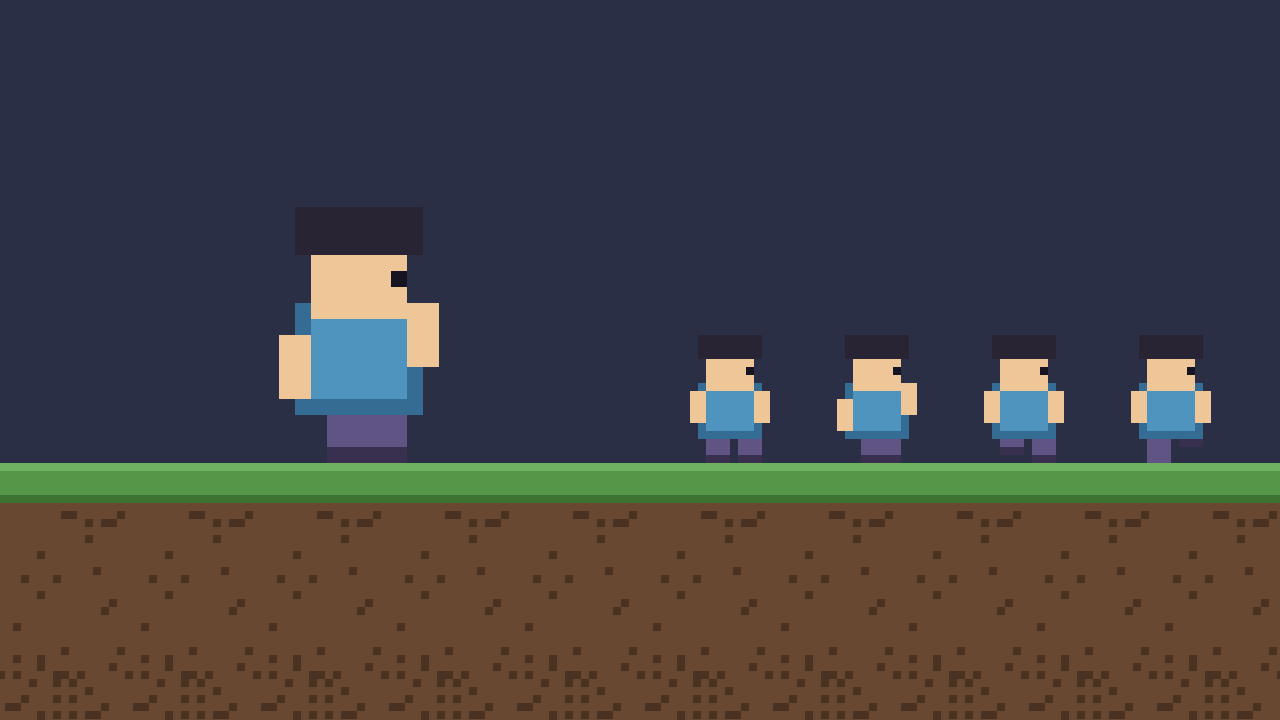
A sprite sheet supplies the frames for idle, run, jump and fall animations. Use the large character to try each clip, change its speed and flip its direction. The smaller characters show the clips side by side.
Off airLivePaused
Sprite animation
2D · 2D
WebGPU: checking…See browser support
Try this
- Switch clips and watch the frame counter: idle is four frames at six a second, run is eight at fourteen.
- Turn Flip on. One set of frames, mirrored — a walk cycle is never drawn twice.
- Pull Speed to a quarter and then to three: the animator scales the clip's own frame rate, not the game's.
Show source code
Source
import { Camera2D, Script, SpriteAnimator, SpriteRenderer, twoD, Vec2 } from "ignifx";import { bootExample } from "../_kit/boot.ts";import { bind, button, readout, select, slider, toggle } from "../_kit/panel.ts";import type { App, AssetHandle, ScriptCallbacks, SpriteAnimationAsset, SpriteAtlasAsset } from "ignifx";/** * Pair an atlas with a sprite-animation document; the animator advances on engine time in `PostUpdate`. * Frame pivots use top-left normalised coordinates; `[0.5, 1]` keeps these sprites on their feet. * Use `flipX` for direction and 16 pixels per unit for this 16-pixel art. Nearest sampling belongs * to the atlas; camera pixel snapping does not change the texture sampler. *//** The clips `runner.spriteanim.json` declares, in the order the select lists them. */const CLIPS = ["idle", "run", "jump", "fall"] as const;/** The design resolution the pixel-perfect camera fits a whole-number zoom to. */const REFERENCE_RESOLUTION = { x: 160, y: 90 } as const;/** Pixels per world metre: one 16-pixel frame is one metre. */const PIXELS_PER_UNIT = 16;/** Where the camera looks, in metres, on a frame wide enough for the reference resolution. */const SHOT = { x: 4.4, y: 1.7 } as const;/** * What a narrow frame has to keep, in metres along X: the large runner's left edge to the last * reference runner's right, with a little air either side. */const CONTENT = { left: 0.2, right: 7.6 } as const;/** * Where the subject stands, in metres. With the panel open at 1280x720 the frame shows x from -0.6 * to about 7.4 m, so the subject and the row both sit left of that. */const SUBJECT = { x: 1.6, y: 0.9 } as const;/** Where the row of one-clip runners starts, and how far apart they stand, in metres. */const ROW = { x: 3.7, y: 0.9, gap: 1 } as const;/** * How many ground tiles are laid per row, and where the strip starts. Ten rows deep, so the earth * still reaches the bottom of a phone held upright, where the frame is far taller than 90 texels. */const GROUND = { count: 12, x: -1.5, y: 0.4, rows: 10 } as const;/** * Keeps the runners in a frame narrower than 16:9. * * @remarks * A pixel-perfect `Camera2D` fits its whole-number zoom to `referenceResolution.y` alone, so a phone * held upright (390x844: zoom 9, under 3 m across) shows two small runners and none of the large * one every control drives. Each frame this raises the reference height until the zoom also fits * {@link CONTENT} across, and centres the camera on it. A frame wide enough for the authored shot * keeps it untouched. The camera never drops far enough to show the bottom of the earth. */class FitContent extends Script implements ScriptCallbacks { /** The namespaced registration id. */ static typeId = "sprite-animation/FitContent"; #camera: Camera2D | null = null; /** Finds the camera on this entity. */ awake(): void { this.#camera = this.entity.requireComponent(Camera2D); } /** Fits the zoom and the shot to the canvas as it is this frame. */ update(): void { const camera = this.#camera; const surface = this.app.renderer.surface; if (camera === null || surface === null || surface.width <= 0 || surface.height <= 0) { return; } const contentPx = (CONTENT.right - CONTENT.left) * PIXELS_PER_UNIT; const height = Math.max(REFERENCE_RESOLUTION.y, (contentPx * surface.height) / surface.width); if (camera.referenceResolution.y !== height) { camera.referenceResolution = { x: REFERENCE_RESOLUTION.x, y: height }; } // The zoom the camera will snap to, so the frame's bottom edge can be kept inside the earth. const zoom = Math.max(1, Math.floor(surface.height / height)); const halfHeight = surface.height / (2 * zoom * PIXELS_PER_UNIT); const earthBottom = GROUND.y - GROUND.rows + 0.5; const x = height > REFERENCE_RESOLUTION.y ? (CONTENT.left + CONTENT.right) / 2 : SHOT.x; const y = Math.max(SHOT.y, earthBottom + halfHeight); const at = this.transform.position2D; if (at.x !== x || at.y !== y) { this.transform.position2D = new Vec2(x, y); } }}/** The dusk sky behind the runners, in sRGB: `#2B2F45`, the same blue as the platformer course. */const CLEAR_COLOR = { r: 0.169, g: 0.184, b: 0.271, a: 1 };/** * Loads the two documents the scene is built from, and the tile sheet the floor is drawn with. * * @remarks * Awaited before `app.start()`, where a completed load settles at once; started after it, a load is * delivered in a later frame's `PreUpdate` and the first frames would draw nothing. * * @param app - The app being set up. * @returns The character's atlas and clips, and the terrain atlas. */async function loadSheets(app: App): Promise<{ readonly atlas: AssetHandle<SpriteAtlasAsset>; readonly clips: AssetHandle<SpriteAnimationAsset>; readonly terrain: AssetHandle<SpriteAtlasAsset>;}> { const [atlas, clips, terrain] = await Promise.all([ app.assets.loadAsync<SpriteAtlasAsset>("2d/runner.atlas.json"), app.assets.loadAsync<SpriteAnimationAsset>("2d/runner.spriteanim.json"), app.assets.loadAsync<SpriteAtlasAsset>("2d/terrain.atlas.json"), ]); return { atlas, clips, terrain };}bootExample({ title: "Sprite animation", // One world metre is one 16-pixel frame. The default is 100, which would draw the runner at a // sixth of her intended size. extensions: [twoD({ pixelsPerUnit: PIXELS_PER_UNIT })], settings: { rendering: { clearColor: CLEAR_COLOR, // Multisampling is off because it would soften exactly the edges pixel art exists to keep // sharp. msaaSamples: 1, }, time: { fixedDeltaTime: 1 / 60 }, sortingLayers: { sortingLayers: ["Terrain", "Default"] }, }, async setup({ app, panel }) { app.registerComponents([FitContent]); const sheets = await loadSheets(app); const ground = sheets.terrain.value.requireFrame("terrain_0"); // A grass-topped row with two rows of plain earth under it, so the strip reaches the bottom of // the frame rather than floating. const dirt = sheets.terrain.value.requireFrame("terrain_1"); for (let row = 0; row < GROUND.rows; row += 1) { for (let index = 0; index < GROUND.count; index += 1) { const tile = app.world.createEntity(`Ground ${String(row)}.${String(index)}`); tile.transform.position2D = new Vec2(GROUND.x + index, GROUND.y - row); tile.addComponent(SpriteRenderer, { sprite: sheets.terrain, sortingLayer: "Terrain" }).frame = row === 0 ? ground : dirt; } } // The subject: one renderer, one animator, and nothing else. Every control on the panel writes // to one of their fields. const hero = app.world.createEntity("Runner"); hero.transform.position2D = new Vec2(SUBJECT.x, SUBJECT.y); // Two metres tall rather than one, so the frames are readable next to the reference row. A // sprite is drawn at its frame size times the transform's scale. hero.transform.localScale2D = new Vec2(2, 2); const renderer = hero.addComponent(SpriteRenderer, { sprite: sheets.atlas, sortingLayer: "Default" }); const animator = hero.addComponent(SpriteAnimator, { animations: sheets.clips, defaultClip: "run", playOnAwake: true, speed: 1, }); // The reference row: the same atlas and the same clips, one animator each, never touched again. for (let index = 0; index < CLIPS.length; index += 1) { const clip = CLIPS[index] ?? "idle"; const entity = app.world.createEntity(`Runner ${clip}`); entity.transform.position2D = new Vec2(ROW.x + index * ROW.gap, ROW.y); entity.addComponent(SpriteRenderer, { sprite: sheets.atlas, sortingLayer: "Default" }); entity.addComponent(SpriteAnimator, { animations: sheets.clips, defaultClip: clip, playOnAwake: true }); } const eye = app.world.createEntity("Main Camera"); eye.transform.position2D = new Vec2(SHOT.x, SHOT.y); eye.addComponent(Camera2D, { pixelPerfect: true, referenceResolution: REFERENCE_RESOLUTION }); eye.addComponent(FitContent); let playing = "run"; panel({ title: "Sprite animation", groups: [ { label: "Clip", controls: [ select("Playing", [...CLIPS], { value: playing, change: (value: string): void => { playing = value; animator.play(value); }, }), slider( "Speed", { min: 0, max: 3, step: 0.05, format: (value: number): string => `${value.toFixed(2)}x` }, bind(animator, "speed"), ), toggle("Flip", bind(renderer, "flipX")), // `play` leaves a clip that is already running alone unless asked to rewind it. button("Restart", (): void => { animator.play(playing, { restart: true }); }), ], }, { label: "Animator", controls: [ // Counted within the clip, so idle reads 1 to 4 and run 1 to 8. The animator's own // `frame` is an index into the whole atlas, which is a different number. readout("Frame", (): string => clipFrame(animator)), readout("Atlas frame", (): string => String(animator.frame)), readout("Clip time", (): string => `${animator.time.toFixed(2)} s`), readout("Advancing", (): string => (animator.isPlaying ? "yes" : "no")), ], }, ], }); },});/** * Writes the frame the animator is on, counted within its clip. * * @param animator - The animator to read. * @returns E.g. `3 of 8`, or `—` when no clip is playing. */function clipFrame(animator: SpriteAnimator): string { const frames = animator.clip?.frames; const index = frames?.indexOf(animator.frame) ?? -1; if (frames === undefined || index < 0) { return "—"; } return `${String(index + 1)} of ${String(frames.length)}`;}