All examples
Audio mixer
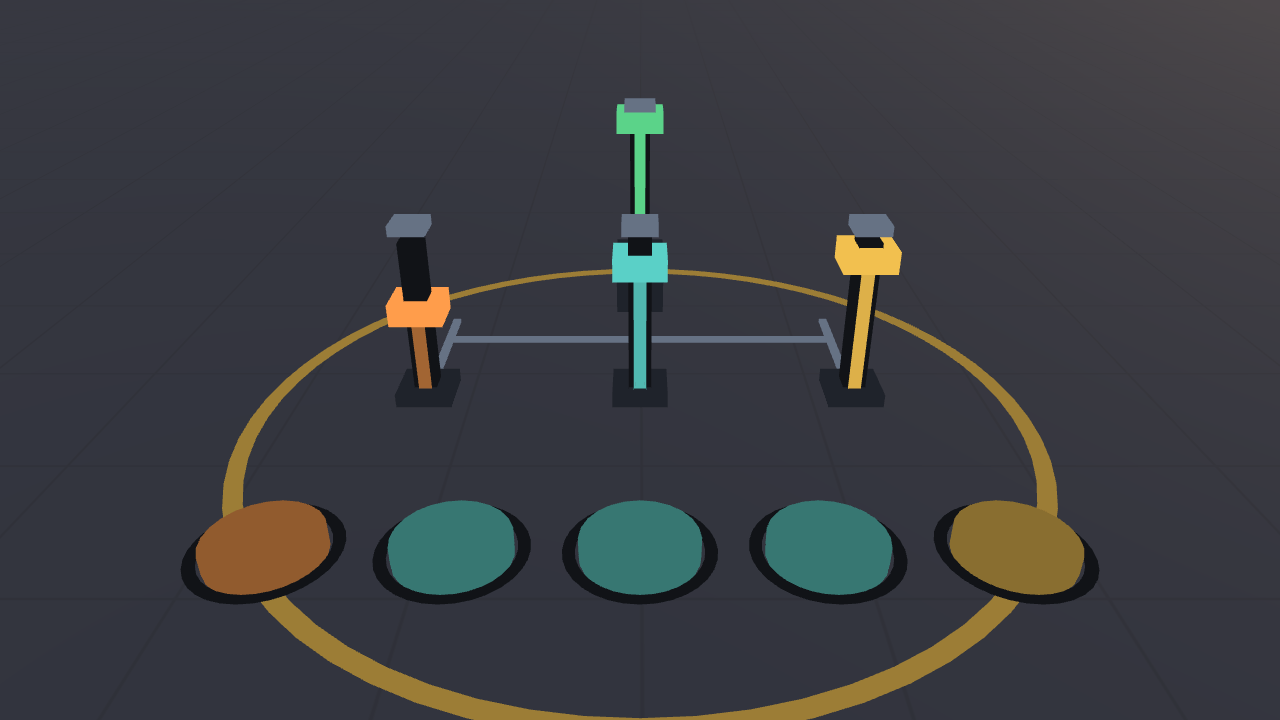
Try a mixer with Master, Music, SFX and UI volume controls. Lowering Master reduces every sound, while the other controls adjust their own groups. Click a pad to play a sound. The ring turns green when the browser allows audio to start.
Off airLivePaused
Audio mixer
Audio · 3D
WebGPU: checking…See browser support
Try this
- Click anywhere: the ring turns green, and the chime queued before that first click plays now.
- Start the music with the leftmost pad, then lower Master: the Music and Master lamps dim while the Music fader stays put.
- With the music on, click the Music fader to mute it, or press a gamepad's face buttons to play the other pads.
Show source code
Source
import { audio, Camera, parseAudioBusesFile } from "ignifx";import { bootExample } from "../_kit/boot.ts";import { percent } from "../_kit/format.ts";import { attachOrbit } from "../_kit/orbit.ts";import { bind, button, readout, slider } from "../_kit/panel.ts";import { createGridGround, createLightRig } from "../_kit/stage.ts";import busesSource from "./game.audio.json?raw";import { attachMixer } from "./mixer.ts";import { createSounds } from "./sounds.ts";import type { MixerDesk, PadId } from "./mixer.ts";import type { PanelControl } from "../_kit/panel.ts";/** * The mixer: a bus tree from an `.audio.json`, four faders that **are** those buses, five pads that * fire sounds through them, and the browser's autoplay lock shown rather than hidden. * * ## The tree comes from the document, before the first frame * * `game.audio.json` beside this file is the mixer: `Master`, with `Music`, `SFX` and `UI` under it. * It is imported with `?raw`, checked by `parseAudioBusesFile` — the same parser the asset loader * uses — and handed to `audio({ busTree })`, which builds the tree during `createApp`. A game * usually names the file as an address (`audio({ buses: "…" })`), which arrives a frame later; * `busTree` is the way to have a custom tree standing before the first frame. * * ## Nothing is audible before a gesture, and nothing is lost either * * `app.audio.state` reads `"locked"` until the audio context runs. Every `play()` made before then * is **held on its voice and flushed in order** the moment it does, so game code never has to * check: the ring on the floor pulses amber, the panel reads `locked`, and the queue counter shows * how many plays are waiting. Clicking anywhere unlocks it — Babylon Lite resumes the context on * the first click in the document — and the panel's Unlock button calls `app.audio.unlock()` * itself, which is what a "tap to start" screen does. * * `sounds.ts` is what the pads play: an `AudioSource`, a one-shot and a `MusicPlayer`, each routed * to its bus. *//** The panel's Play buttons, and the pad each one fires. */const PAD_BUTTONS: readonly (readonly [string, PadId])[] = [ ["Pickup", "pickup"], ["Jump", "jump"], ["Land", "land"], ["UI click", "click"], ["Music", "music"],];/** The buses, in fader order: the names `game.audio.json` declares. */const BUSES = ["Master", "Music", "SFX", "UI"] as const;/** * Where the camera starts. Far enough back that the row of pads fits the square frame the orbit * keeps on a phone held upright, end pads included; a 16:9 frame has room to spare either way. */const SHOT = { yaw: 0, pitch: 30, distance: 6.6, target: { x: 0, y: 0.5, z: 0.2 } } as const;/** The clear colour, in sRGB: the site's dark `--bg`, which the floor fades into. */const CLEAR = { r: 0.051, g: 0.063, b: 0.082, a: 1 } as const;/** `JSON.parse` answers `any`; the document is `unknown` until the parser has checked it. */const busesJson: unknown = JSON.parse(busesSource);bootExample({ title: "Audio mixer", extensions: [audio({ busTree: parseAudioBusesFile(busesJson, "game.audio.json"), masterVolume: 0.9 })], settings: { rendering: { clearColor: CLEAR, msaaSamples: 4, // No `shadows` feature: nothing on the desk casts one. features: {}, }, time: { fixedDeltaTime: 1 / 60 }, }, async setup({ app, panel, random }) { const eye = app.world.createEntity("Main Camera"); const camera = eye.addComponent(Camera, { near: 0.05, far: 120, fov: 42 }); attachOrbit(app, eye, { ...SHOT, minDistance: 2.4, maxDistance: 12, maxPitch: 72 }); // Awaited before `app.start()`: a load that completes before the loop runs settles at once, // where one awaited afterwards waits for a `PreUpdate`. The fade is sized from the orbit. await createGridGround(app, { color: { r: 0.26, g: 0.28, b: 0.33, a: 1 }, fade: { subjectRadius: 2.5 } }); createLightRig(app, { focus: { x: 0, y: 0.4, z: 0.2 }, keyIntensity: 2.2, rimIntensity: 0.8, shadows: false }); const sounds = await createSounds(app, random); // The desk is built next, and the music pad needs it to show the loop is on. let desk: MixerDesk | null = null; desk = attachMixer(app, camera, { play: (pad: PadId): void => { sounds.play(pad); if (pad === "music") { desk?.latch("music", sounds.musicOn); // A loop sounds until it is stopped, so its lamps stay lit rather than flashing once. desk?.sustain("Music", sounds.musicOn); } }, // One bus, one flag: `muted` silences a bus and everything under it without losing where its // fader was. Muting `Master` is how a game's "mute all" works. toggleMute: (name: string): void => { const bus = app.audio.bus(name); bus.muted = !bus.muted; }, }); // A start-up chime, made while the context is still locked. It is **not** dropped: the voice // holds it and the service flushes every held play, in the order it was asked for, the moment // the context runs — which is why the queue counter below reads 1 before anyone has clicked and // "flushed" afterwards. A game's menu music is the same call in the same place. sounds.play("pickup"); desk.ping("SFX"); // A slider and a button per bus, and one readout for the mutes: a button cannot go stale when a // click on a fader in the scene mutes the same bus, where a checkbox would. const faders: PanelControl[] = BUSES.flatMap((name: string): readonly PanelControl[] => { const bus = app.audio.bus(name); return [ slider(name, { min: 0, max: 1, step: 0.01, format: percent }, bind(bus, "volume")), button(`Mute ${name}`, (): void => { bus.muted = !bus.muted; }), ]; }); faders.push( readout("Muted", (): string => { const muted = BUSES.filter((name: string) => app.audio.bus(name).muted); return muted.length === 0 ? "none" : muted.join(", "); }), // The output gain sits after every bus, which is why it is not a fader on the desk: it is the // system volume, not part of the tree. slider("Output gain", { min: 0, max: 1, step: 0.01, format: percent }, bind(app.audio, "masterVolume")), ); panel({ title: "Audio mixer", groups: [ { label: "Sound", controls: [ readout("State", (): string => app.audio.state), readout("Queued while locked", (): string => { if (sounds.queued === 0) { return "0"; } return `${String(sounds.queued)} ${app.audio.isUnlocked ? "flushed" : "waiting"}`; }), button("Unlock", (): void => { // A real gesture: a click handler is exactly where a resume belongs. app.audio.unlock().catch((error: unknown): void => { app.log.warn("the browser refused to start audio:", error); }); }), ], }, { label: "Mixer", controls: faders }, { label: "Play", // Through the desk, like a click on a pad, so every play lights its lamps. controls: PAD_BUTTONS.map(([label, id]) => button(label, (): void => { desk.fire(id); }), ), }, { label: "Frame", collapsed: true, controls: [ readout("Music playing", (): string => (sounds.music.isPlaying ? "yes" : "no")), readout("Draw calls", (): string => String(app.renderer.drawCalls)), ], }, ], }); },});{ "format": "ignifx.audiobuses", "formatVersion": 1, "buses": [ { "name": "Master", "parent": "", "volume": 1 }, { "name": "Music", "parent": "Master", "volume": 0.55, "pausable": true }, { "name": "SFX", "parent": "Master", "volume": 0.85, "pausable": true }, { "name": "UI", "parent": "Master", "volume": 0.9, "pausable": false } ]}import { AUDIO_ASSET_TYPE, AudioSource, MusicPlayer } from "ignifx";import type { App, AssetHandle, AudioClip } from "ignifx";import type { PadId } from "./mixer.ts";/** * What the pads play, and the two ways ignifx plays a sound. * * The three impact pads own an `AudioSource`: a component with a clip, a bus and an instance limit, * which is what a thing in the world that makes a noise should be. The UI click goes through * `app.audio.playOneShot`, which is fire-and-forget and needs no entity. `pitch` is a **field** on * the source rather than an argument, because Babylon Lite fixes an instance's playback rate when * it starts — so setting it applies to the next `play()`. The music is a `MusicPlayer`, which owns * the crossfade and the loop. *//** The clips the mixer plays, by the address the asset manifest resolves. */const CLIPS = { music: "audio/ambient.wav", pickup: "audio/pickup.wav", jump: "audio/jump.wav", land: "audio/land.wav", click: "audio/ui-click.wav",} as const;/** How much a one-shot's pitch may wander, so a repeated impact does not sound like a machine. */const PITCH_SPREAD = 0.14;/** The sounds, ready to play. */export interface Sounds { /** * Plays what one pad plays; the music pad starts the loop, or stops it. * * @param pad - Which pad. */ play(pad: PadId): void; /** Whether the music loop is on. */ readonly musicOn: boolean; /** The music player, for its `isPlaying` readout. */ readonly music: MusicPlayer; /** How many plays were made while the audio was locked; none of them is dropped. */ readonly queued: number;}/** * Loads every clip, builds the sources, and answers the function each pad calls. * * @remarks * Awaited before `app.start()`, where a completed load settles at once. * * @param app - The running app; needs `audio()` with a `SFX`, a `UI` and a `Music` bus. * @param random - The kit's seeded generator; an example never calls `Math.random`. * @returns The sounds. */export async function createSounds(app: App, random: () => number): Promise<Sounds> { const load = (address: string): AssetHandle<AudioClip> => app.assets.load<AudioClip>(address, { type: AUDIO_ASSET_TYPE }); const clips = { music: load(CLIPS.music), pickup: load(CLIPS.pickup), jump: load(CLIPS.jump), land: load(CLIPS.land), click: load(CLIPS.click), }; await Promise.all(Object.values(clips).map((handle: AssetHandle<AudioClip>) => handle.promise)); // One `AudioSource` per impact: a clip, a bus and an instance limit. Past `maxInstances` the // oldest instance is stolen, which is what stops a held-down pad stacking into a roar. const source = (name: string, clip: AssetHandle<AudioClip>): AudioSource => app.world .createEntity(`${name} source`) .addComponent(AudioSource, { clip, bus: "SFX", volume: 0.85, maxInstances: 6 }); const impacts = { pickup: source("Pickup", clips.pickup), jump: source("Jump", clips.jump), land: source("Land", clips.land), }; const music = app.world .createEntity("Music") .addComponent(MusicPlayer, { crossfadeSeconds: 1.5, loopTrack: true, volume: 1 }); const state = { musicOn: false, queued: 0 }; return { music, get musicOn(): boolean { return state.musicOn; }, get queued(): number { return state.queued; }, play(pad: PadId): void { if (pad === "music") { state.musicOn = !state.musicOn; if (state.musicOn) { music.play(clips.music.value, { fadeIn: 1.2 }); } else { music.stop({ fadeOut: 0.8 }); } } else if (pad === "click") { // Fire and forget, on a bus `app.pause()` never pauses: a menu keeps its own clicks audible. app.audio.playOneShot(clips.click.value, { bus: "UI", volume: 0.8 }); } else { const emitter = impacts[pad]; emitter.pitch = 1 - PITCH_SPREAD / 2 + random() * PITCH_SPREAD; emitter.play(); } // Counted so the panel can show that a play made before the unlock was held, not dropped. if (app.audio.isLocked && app.audio.queueWhileLocked) { state.queued += 1; } }, };}import { clamp, createMaterialAsset, createRay, defineInputActions, MeshAsset, MeshRenderer, pbrMaterialDefinition, Script,} from "ignifx";import type { App, AssetHandle, AudioBus, Camera, ColorLike, Entity, InputAction, InputActionsDefinition, MaterialAsset, Ray, ScriptCallbacks,} from "ignifx";/** * The mixing desk `audio-mixer` is operated on: four faders that are the four buses of * `game.audio.json`, five pads that fire the sounds, and a ring on the floor that is the browser's * autoplay lock. * * Everything here is geometry, for the reason the example's poster gives away: the poster and the * golden are captured with `?nopanel=1`, so a mixer that only existed in the kit's parameter panel * would not be in the picture. The panel keeps the numbers; this keeps the instrument. * * ## What each part reads * * | Part | Reads | * | --------------- | ------------------------------------------------------------------------ | * | Fader knob | `bus.volume` — the bus's **own** gain, which is what a fader is | * | Fader fill | The same, drawn from the plinth up to the knob | * | Signal lamp | `bus.effectiveVolume` — own gain times every parent's — while it sounds | * | Knob colour | `bus.muted` | * | Rails | Nothing. They are the tree: three children into one root | * | Floor ring | `app.audio.state`, pulsing while it reads `"locked"` | * * Turning `Master` down dims every lit signal lamp while the three faders stay where they are, * which is the difference between `volume` and `effectiveVolume` made visible. * * ## Clicks, and why a click is not a press * * The camera is the kit's orbit camera, which drags on `<Pointer>/press` — so a pad that fired on * press would fire every time the visitor turned the scene. A click is therefore a press and a * release with less than {@link CLICK_SLOP} backing-store pixels between them, which is what a * game does and what makes both gestures usable on a touch screen. *//** The site's dark palette (`plan/02-design-system.md` §2.3), decoded to sRGB `0…1`. */const INK = { /** A plinth: a step lighter than the palette's `--surface`, which reads as black at this size. */ surface: { r: 0.098, g: 0.118, b: 0.153, a: 1 }, /** A well: a fader's track, a pad's rim. Darker than the floor, so a knob sits *in* it. */ sunk: { r: 0.035, g: 0.043, b: 0.059, a: 1 }, /** A knob at rest, before its accent is written over it. */ rule: { r: 0.235, g: 0.275, b: 0.337, a: 1 }, /** A quiet mark: a rail, a lamp that is off. */ quiet: { r: 0.4, g: 0.451, b: 0.522, a: 1 }, /** `--flame`: the Music bus and its pad. */ flame: { r: 1, g: 0.62, b: 0.29, a: 1 }, /** `--cool`: the SFX bus, its pads, and every fader's fill. */ cool: { r: 0.353, g: 0.82, b: 0.784, a: 1 }, /** `--ok`: the Master bus, and the floor ring once the audio context is running. */ ok: { r: 0.357, g: 0.831, b: 0.541, a: 1 }, /** `--warn`: the UI bus, its pad, and the floor ring while the audio is locked. */ warn: { r: 0.949, g: 0.757, b: 0.306, a: 1 }, /** A muted fader knob. */ muted: { r: 0.55, g: 0.16, b: 0.16, a: 1 }, /** White: the frame a pad was clicked in. */ hot: { r: 1, g: 1, b: 1, a: 1 },} as const;/** How far a pointer may travel between press and release and still count as a click, in pixels. */const CLICK_SLOP = 12;/** A fader's travel, in metres: the length of its track. */const FADER_TRAVEL = 0.9;/** A fader's track width, in metres. */const FADER_WIDTH = 0.13;/** How high a fader's track starts above the floor, in metres. */const FADER_BASE = 0.07;/** A pad's diameter, in metres. */const PAD_DIAMETER = 0.56;/** How long a pad stays lit after it was clicked, in seconds. */const PAD_FLASH_SECONDS = 0.18;/** How long a bus's signal lamp stays lit after something played on it, in seconds. */const SIGNAL_SECONDS = 0.32;/** How fast the floor ring pulses while the audio is locked, in cycles per second. */const LOCK_PULSE_HZ = 0.6;/** The smallest scale an element is given, so no transform is ever singular. */const MIN_SCALE = 0.004;/** How many steps a level is quantised to before it is written. */const LEVEL_STEPS = 48;/** The action map the desk reads its clicks from. Its own name, so the kit's `KitOrbit` is intact. */export const MIXER_ACTION_MAP = "AudioMixer";/** Which pad was clicked. */export type PadId = "click" | "jump" | "land" | "music" | "pickup";/** The action that fires each pad from a gamepad, as {@link MIXER_ACTIONS} names it. */const PAD_BUTTONS: Readonly<Record<PadId, string>> = { music: "padMusic", pickup: "padPickup", jump: "padJump", land: "padLand", click: "padClick",};/** What the desk asks the example to do when a pad is clicked. */export interface MixerHooks { /** * Plays whatever that pad plays. * * @param pad - The pad that was clicked. */ readonly play: (pad: PadId) => void; /** * Toggles a bus's mute, when a fader knob is clicked. * * @param bus - The bus name. */ readonly toggleMute: (bus: string) => void;}/** The actions the desk binds: the unified pointer's press and position, and a button per pad. */export const MIXER_ACTIONS: InputActionsDefinition = defineInputActions({ maps: [ { name: MIXER_ACTION_MAP, actions: [ { name: "deskPress", type: "button", bindings: [{ path: "<Pointer>/press" }] }, { name: "deskPointer", type: "vector2", bindings: [{ path: "<Pointer>/position" }] }, // A gamepad plays the pads too: one face button each, and Start for the music. { name: "padMusic", type: "button", bindings: [{ path: "<Gamepad>/start" }] }, { name: "padPickup", type: "button", bindings: [{ path: "<Gamepad>/buttonSouth" }] }, { name: "padJump", type: "button", bindings: [{ path: "<Gamepad>/buttonEast" }] }, { name: "padLand", type: "button", bindings: [{ path: "<Gamepad>/buttonWest" }] }, { name: "padClick", type: "button", bindings: [{ path: "<Gamepad>/buttonNorth" }] }, ], }, ],});/** One element that changes colour. */interface Lamp { /** The element's own material. */ readonly material: AssetHandle<MaterialAsset>; /** The colour at level 0. */ readonly off: ColorLike; /** The colour at level 1. */ readonly on: ColorLike; /** The last level written, quantised, so an unchanged lamp costs nothing. */ written: number;}/** One fader: the bus it is, the knob that shows its gain, and the lamp that shows its signal. */interface Fader { /** The bus name, as `game.audio.json` declares it. */ readonly name: string; /** The bus, or `null` when the tree does not declare it. */ readonly bus: AudioBus | null; /** The knob, slid up the track by the bus's own gain. */ readonly knob: Entity; /** The track behind it; clickable too, so the whole fader mutes its bus. */ readonly track: Entity; /** The knob's lamp: the bus's accent, or red when the bus is muted. */ readonly knobLamp: Lamp; /** The fill under the knob. */ readonly fill: Entity; /** The fill's lamp. */ readonly fillLamp: Lamp; /** The lamp on top, lit by `effectiveVolume` while the bus is busy. */ readonly signal: Lamp; /** Where the track starts above the floor, in metres: `FADER_BASE` plus the fader's own lift. */ readonly base: number; /** Seconds of signal left, counted down on the unscaled clock. */ busy: number; /** How many sustained sounds hold the lamp lit: a running music loop on this bus or under it. */ held: number;}/** One pad: a drum you click to fire a sound. */interface Pad { /** Which pad it is. */ readonly id: PadId; /** The bus the sound it fires is routed to, so a click can light the right lamps. */ readonly bus: string; /** The disc's lamp. */ readonly lamp: Lamp; /** Seconds of flash left. */ flash: number; /** Whether the pad is a latch that is currently on, which is how the music pad reads. */ latched: boolean; /** The gamepad button that fires it, or `null` when the map declares none. */ button: InputAction | null;}/** The parts one desk is made of. */interface Parts { /** The four faders, left to right, root last. */ readonly faders: readonly Fader[]; /** The five pads, left to right. */ readonly pads: readonly Pad[]; /** The ring on the floor: the autoplay lock. */ readonly ring: Lamp; /** Which entity does what when it is clicked. */ readonly targets: ReadonlyMap<Entity, () => void>; /** The camera the click's ray is cast through. */ readonly camera: Camera; /** The press action. */ readonly press: InputAction | null; /** The pointer-position action, in backing-store pixels. */ readonly pointer: InputAction | null; /** What firing a pad does beyond lighting the desk. */ readonly hooks: MixerHooks;}/** * Writes a lamp's colour for a level in `0…1`. * * @param lamp - The lamp to write. * @param level - How lit it is, `0` to `1`. */function setLevel(lamp: Lamp, level: number): void { const step = Math.round(clamp(level, 0, 1) * LEVEL_STEPS); if (step === lamp.written) { return; } lamp.written = step; const t = step / LEVEL_STEPS; lamp.material.value.setBaseColor({ r: lamp.off.r + (lamp.on.r - lamp.off.r) * t, g: lamp.off.g + (lamp.on.g - lamp.off.g) * t, b: lamp.off.b + (lamp.on.b - lamp.off.b) * t, a: 1, });}/** * A dark shade of one colour: what a lamp of that colour looks like switched off. * * @remarks * Lamps rest at a shade of their **own** accent rather than at one neutral grey, because a level * between a blue-grey and an orange passes through mud, and half the desk sits at a level between * the two most of the time. * * @param color - The accent. * @param scale - How much of it is left; `0.22` is the resting shade. * @returns The darkened colour, opaque. */function shade(color: ColorLike, scale: number): ColorLike { return { r: color.r * scale, g: color.g * scale, b: color.b * scale, a: 1 };}/** * The colour a bus's accent is. * * @param name - The bus name. * @returns Its accent colour. */function accentOf(name: string): ColorLike { if (name === "Music") { return INK.flame; } if (name === "UI") { return INK.warn; } if (name === "Master") { return INK.ok; } return INK.cool;}/** * The desk's per-frame update: read the buses, write the geometry, and route a click. * * @remarks * A `Script`, so it runs in `Update` with everything else and the devtools inspector lists it. */export class MixerDesk extends Script implements ScriptCallbacks { /** The namespaced registration id. */ static typeId = "audio-mixer/MixerDesk"; #parts: Parts | null = null; /** Where the pointer was pressed, in backing-store pixels; `null` while nothing is held. */ #pressedAt: { x: number; y: number } | null = null; /** * Reused so the per-frame path allocates nothing (coding standards §7). * * @remarks * `createRay()` rather than an object literal, and the difference is not cosmetic: a ray's * `length` is how far it reaches, `createRay` sets it to `Number.MAX_VALUE`, and a literal * that forgets it stops the cast short of everything in the scene. */ readonly #ray: Ray = createRay(); /** * Hands the script the parts {@link attachMixer} built. * * @param parts - The desk's parts. */ install(parts: Parts): void { this.#parts = parts; } /** * Pings one bus's signal lamp, and its ancestors' with it. * * @remarks * The example calls this when it plays something, because nothing in `app.audio` reports which * bus a sound is on: a voice is created against a bus and the mixer is a chain of gains, not a * meter. Walking to the root is what makes `Master`'s lamp light for every sound. * * @param bus - The bus a sound was just played on. */ ping(bus: string): void { const parts = this.#parts; if (parts === null) { return; } for (const fader of parts.faders) { if (fader.name === bus || isAncestorOf(fader.name, parts, bus)) { fader.busy = SIGNAL_SECONDS; } } } /** * Keeps one bus's signal lamp, and its ancestors', lit for as long as a sound on it lasts, which * is how a music loop shows on the desk. * * @param bus - The bus the sound plays on. * @param on - `true` when the sound starts, `false` when it stops; calls pair up. */ sustain(bus: string, on: boolean): void { const parts = this.#parts; if (parts === null) { return; } for (const fader of parts.faders) { if (fader.name === bus || isAncestorOf(fader.name, parts, bus)) { fader.held = Math.max(0, fader.held + (on ? 1 : -1)); } } } /** * Fires one pad, the way a click on it does: flashes it, lights its bus's lamps, and plays it. * The panel's Play buttons and the gamepad come through here too, so every play shows on the desk. * * @param id - Which pad. */ fire(id: PadId): void { const parts = this.#parts; const pad = parts?.pads.find((candidate: Pad) => candidate.id === id); if (parts === null || pad === undefined) { return; } pad.flash = PAD_FLASH_SECONDS; this.ping(pad.bus); parts.hooks.play(id); } /** * Latches or unlatches one pad, which is how the music pad shows that the loop is running. * * @param pad - Which pad. * @param on - Whether it is latched on. */ latch(pad: PadId, on: boolean): void { const found = this.#parts?.pads.find((candidate: Pad) => candidate.id === pad); if (found !== undefined) { found.latched = on; } } /** Reads the buses and the click, and writes the desk. */ update(): void { const parts = this.#parts; if (parts === null) { return; } const unscaled = this.app.time.unscaledDeltaTime; this.#readClick(parts); for (const pad of parts.pads) { if (pad.button?.wasPressedThisFrame === true) { this.fire(pad.id); } } for (const fader of parts.faders) { updateFader(fader, unscaled); } for (const pad of parts.pads) { updatePad(pad, unscaled); } this.#updateRing(parts); } /** * Turns a press-and-release into a click on whatever was under it. * * @param parts - The desk's parts. */ #readClick(parts: Parts): void { const press = parts.press; const pointer = parts.pointer; if (press === null || pointer === null) { return; } if (press.wasPressedThisFrame) { this.#pressedAt = { x: pointer.vector.x, y: pointer.vector.y }; } // No early return after the press: a frame's events are all applied together in `PreUpdate`, // so a press and its release can resolve in the same frame and a handler that returned above // would drop that click. A click shorter than one frame is a different thing and is not // recoverable here at all — the control is back at zero before anything reads it, so neither // edge flag is ever set. `app.input.events` still holds both records for a game that needs // them; an action reports the state of a control, not the history of it. if (!press.wasReleasedThisFrame) { return; } const from = this.#pressedAt; this.#pressedAt = null; if (from === null || Math.hypot(pointer.vector.x - from.x, pointer.vector.y - from.y) > CLICK_SLOP) { return; } // `<Pointer>/position` is in the canvas's **backing-store pixels**, which is the space // `Camera.screenToRay` and `renderer.pickAsync` both speak — so the action's vector goes // straight in. DOM code is the side that divides by `devicePixelRatio`. const ray = parts.camera.screenToRay(pointer.vector.x, pointer.vector.y, this.#ray); if (ray === null) { return; } // A synchronous CPU raycast over the pickable renderers, rather than `pickAsync`, because the // answer is wanted in this frame and a desk is a handful of meshes. const hit = this.app.world.raycastRender(ray); if (hit === null) { return; } const run = parts.targets.get(hit.entity); if (run !== undefined) { run(); } } /** * Lights the ring on the floor: amber and pulsing while the audio is locked, green once it runs. * * @remarks * The pulse is on `time.time`, the **scaled** clock, so `?static=1` — which stops the clock * before the first frame — freezes the ring at a known brightness and the golden does not * depend on when the page happened to load. * * @param parts - The desk's parts. */ #updateRing(parts: Parts): void { const running = this.app.audio.state === "running"; const pulse = running ? 1 : 0.5 + 0.5 * Math.sin(this.app.time.time * LOCK_PULSE_HZ * Math.PI * 2); // The two states are two different colours, not two ends of one ramp: a level between amber and // green is mud, and the ring is the one thing on the desk that has to be readable at a glance. const step = Math.round(pulse * LEVEL_STEPS) + (running ? LEVEL_STEPS + 1 : 0); if (step === parts.ring.written) { return; } parts.ring.written = step; const from = running ? INK.ok : shade(INK.warn, 0.3); const to = running ? INK.ok : INK.warn; parts.ring.material.value.setBaseColor({ r: from.r + (to.r - from.r) * pulse, g: from.g + (to.g - from.g) * pulse, b: from.b + (to.b - from.b) * pulse, a: 1, }); }}/** * Whether one bus is an ancestor of another, by walking the tree the service built. * * @param candidate - The bus that might be an ancestor. * @param parts - The desk's parts, for the fader table. * @param of - The bus a sound was played on. * @returns `true` when `candidate` is `of`'s parent, grandparent, and so on. */function isAncestorOf(candidate: string, parts: Parts, of: string): boolean { let bus = parts.faders.find((fader: Fader) => fader.name === of)?.bus?.parent ?? null; while (bus !== null) { if (bus.name === candidate) { return true; } bus = bus.parent; } return false;}/** * Slides one fader's knob, scales its fill, and lights its signal lamp. * * @param fader - The fader to update. * @param unscaled - The unscaled frame delta, in seconds. */function updateFader(fader: Fader, unscaled: number): void { const bus = fader.bus; const own = clamp(bus?.volume ?? 0, 0, 1); fader.knob.transform.localPosition.y = fader.base + own * FADER_TRAVEL; const height = Math.max(own * FADER_TRAVEL, MIN_SCALE); fader.fill.transform.localScale.set(FADER_WIDTH * 0.55, height, FADER_WIDTH * 0.55); fader.fill.transform.localPosition.y = fader.base + height / 2; setLevel(fader.fillLamp, own); setLevel(fader.knobLamp, bus?.muted === true ? 0 : 1); if (fader.busy > 0) { fader.busy = Math.max(fader.busy - unscaled, 0); } // `effectiveVolume` is the bus's own gain times every parent's, so turning `Master` down dims // every lamp on the desk while the three faders under it stay exactly where they are. setLevel(fader.signal, fader.busy > 0 || fader.held > 0 ? clamp(bus?.effectiveVolume ?? 0, 0, 1) : 0);}/** * Lights one pad: white for the frames after a click, its accent while it is latched on. * * @param pad - The pad to update. * @param unscaled - The unscaled frame delta, in seconds. */function updatePad(pad: Pad, unscaled: number): void { if (pad.flash > 0) { pad.flash = Math.max(pad.flash - unscaled, 0); } setLevel(pad.lamp, pad.flash > 0 ? 1 : pad.latched ? 0.9 : 0.44);}/** * Builds an unlit material for one part of the desk. * * @param app - The app the asset belongs to. * @param name - The material's name. * @param color - The colour it starts at. * @returns The handle, with one holder. */function createInkMaterial(app: App, name: string, color: ColorLike): AssetHandle<MaterialAsset> { return createMaterialAsset( app, pbrMaterialDefinition({ name: `mixer/${name}`, baseColor: color, metallic: 0, roughness: 1, unlit: true, doubleSided: true, }), [], );}/** Where a part sits and how big it is, in the parent's metres. */interface Placement { /** Metres along X. */ readonly x: number; /** Metres along Y. */ readonly y: number; /** Metres along Z. */ readonly z: number; /** Scale along X. */ readonly sx: number; /** Scale along Y. */ readonly sy: number; /** Scale along Z. */ readonly sz: number;}/** * Adds one part of the desk. * * @param app - The app. * @param name - The entity's name, which the devtools scene tree shows. * @param mesh - The template it clones. * @param material - The material it wears. * @param at - Where it sits and how big it is. * @param pickable - Whether a click can find it. * @returns The entity. */function addPart( app: App, name: string, mesh: AssetHandle<MeshAsset>, material: AssetHandle<MaterialAsset>, at: Placement, pickable = false,): Entity { const entity = app.world.createEntity(name); entity.transform.localPosition.set(at.x, at.y, at.z); entity.transform.localScale.set(at.sx, at.sy, at.sz); entity.addComponent(MeshRenderer, { mesh, materials: [material], castShadows: false, receiveShadows: false, pickable, }); return entity;}/** The templates the desk shares. */interface Shapes { /** A unit box: plinths, tracks, fills, knobs, rails, lamps. */ readonly box: AssetHandle<MeshAsset>; /** A unit cylinder standing along Y: the pads. */ readonly disc: AssetHandle<MeshAsset>; /** A unit ring in the XZ plane: the pad rims. */ readonly ring: AssetHandle<MeshAsset>; /** A much thinner unit ring: the floor ring, whose tube would otherwise scale to a hoop. */ readonly hoop: AssetHandle<MeshAsset>;}/** * Builds one fader. * * @param app - The app. * @param shapes - The shared templates. * @param name - The bus's name. * @param x - Where the fader stands, in metres right of the desk's centre. * @param z - Where the fader stands, in metres forward of the desk's centre. * @param lift - How far the whole fader is raised, in metres; the root stands on a taller plinth. * @returns The fader, and the knob a click can find. */function addFader(app: App, shapes: Shapes, name: string, x: number, z: number, lift: number): Fader { const accent = accentOf(name); const base = FADER_BASE + lift; addPart(app, `${name} plinth`, shapes.box, createInkMaterial(app, `${name} plinth`, INK.surface), { x, y: (base + 0.01) / 2, z, sx: 0.32, sy: base + 0.01, sz: 0.32, }); // The track is pickable as well as the knob: a knob is nine centimetres tall and a click has to // land somewhere, so the whole fader is the target for its bus's mute. const track = addPart( app, `${name} track`, shapes.box, createInkMaterial(app, `${name} track`, INK.sunk), { x, y: base + FADER_TRAVEL / 2, z, sx: FADER_WIDTH, sy: FADER_TRAVEL, sz: FADER_WIDTH }, true, ); const fillMaterial = createInkMaterial(app, `${name} fill`, accent); const fill = addPart(app, `${name} fill`, shapes.box, fillMaterial, { x, y: base, z: z - 0.045, sx: FADER_WIDTH * 0.55, sy: MIN_SCALE, sz: FADER_WIDTH * 0.55, }); const knobMaterial = createInkMaterial(app, `${name} knob`, accent); const knob = addPart( app, `${name} knob`, shapes.box, knobMaterial, { x, y: base, z, sx: 0.3, sy: 0.13, sz: 0.26 }, true, ); const signalMaterial = createInkMaterial(app, `${name} signal`, INK.quiet); addPart(app, `${name} signal`, shapes.box, signalMaterial, { x, y: base + FADER_TRAVEL + 0.08, z, sx: 0.2, sy: 0.06, sz: 0.2, }); return { name, bus: app.audio.tryBus(name), knob, track, knobLamp: { material: knobMaterial, off: INK.muted, on: accent, written: -1 }, fill, fillLamp: { material: fillMaterial, off: shade(accent, 0.22), on: accent, written: -1 }, signal: { material: signalMaterial, off: INK.quiet, on: accent, written: -1 }, base, busy: 0, held: 0, };}/** * Builds one pad. * * @param app - The app. * @param shapes - The shared templates. * @param id - Which pad it is. * @param label - The pad's name, for the scene tree. * @param bus - The bus the sound it fires is routed to. * @param x - Where it sits, in metres right of the desk's centre. * @param accent - Its accent colour, which is its bus's. * @returns The pad and its clickable disc. */function addPad( app: App, shapes: Shapes, id: PadId, label: string, bus: string, x: number, accent: ColorLike,): { readonly pad: Pad; readonly disc: Entity } { const z = -0.72; addPart(app, `${label} rim`, shapes.ring, createInkMaterial(app, `${label} rim`, INK.sunk), { x, y: 0.03, z, sx: PAD_DIAMETER + 0.09, sy: 0.07, sz: PAD_DIAMETER + 0.09, }); const material = createInkMaterial(app, `${label} pad`, accent); const disc = addPart( app, `${label} pad`, shapes.disc, material, { x, y: 0.05, z, sx: PAD_DIAMETER, sy: 0.1, sz: PAD_DIAMETER }, true, ); return { pad: { id, bus, lamp: { material, off: shade(accent, 0.24), on: accent, written: -1 }, flash: 0, latched: false, button: null, }, disc, };}/** * Builds the desk and attaches the script that drives it. * * @param app - The running app; needs `audio()`, `input()`, and a built bus tree. * @param camera - The camera a click's ray is cast through. * @param hooks - What a click on a pad or a knob does. * @returns The desk's script, so the example can ping its lamps and latch its music pad. * * @example * ```ts * const desk = attachMixer(app, camera, { play, toggleMute }); * desk.ping("SFX"); * ``` */export function attachMixer(app: App, camera: Camera, hooks: MixerHooks): MixerDesk { app.registerComponents([MixerDesk]); app.input.loadActions(MIXER_ACTIONS); const shapes: Shapes = { box: MeshAsset.box(app, { size: 1 }), disc: MeshAsset.cylinder(app, { diameter: 1, height: 1, tessellation: 24 }), ring: MeshAsset.torus(app, { diameter: 1, thickness: 0.09, tessellation: 32 }), hoop: MeshAsset.torus(app, { diameter: 1, thickness: 0.022, tessellation: 64 }), }; const faders = [ addFader(app, shapes, "Music", -1.25, 0.75, 0), addFader(app, shapes, "SFX", 0, 0.75, 0), addFader(app, shapes, "UI", 1.25, 0.75, 0), // The root stands behind the three and a third of a metre higher, so its column clears the // fader in front of it from the camera's own start pose. addFader(app, shapes, "Master", 0, 2.05, 0.34), ]; // Three rails into one: the routing `game.audio.json` declares, drawn rather than described. for (const x of [-1.25, 0, 1.25]) { addPart(app, `Rail ${String(x)}`, shapes.box, createInkMaterial(app, `rail ${String(x)}`, INK.quiet), { x, y: 0.012, z: 1.24, sx: 0.05, sy: 0.024, sz: 0.98, }); } addPart(app, "Rail bus", shapes.box, createInkMaterial(app, "rail bus", INK.quiet), { x: 0, y: 0.012, z: 1.44, sx: 2.55, sy: 0.024, sz: 0.05, }); const built = [ addPad(app, shapes, "music", "Music loop", "Music", -1.7, INK.flame), addPad(app, shapes, "pickup", "Pickup", "SFX", -0.85, INK.cool), addPad(app, shapes, "jump", "Jump", "SFX", 0, INK.cool), addPad(app, shapes, "land", "Land", "SFX", 0.85, INK.cool), addPad(app, shapes, "click", "UI click", "UI", 1.7, INK.warn), ]; const ringMaterial = createInkMaterial(app, "lock ring", INK.warn); addPart(app, "Lock ring", shapes.hoop, ringMaterial, { x: 0, y: 0.014, z: 0.45, sx: 4.3, sy: 0.06, sz: 4.3, }); const desk = app.world.createEntity("Mixer").addComponent(MixerDesk); const targets = new Map<Entity, () => void>(); for (const entry of built) { // The desk lights its own lamps, so the example's hook only has to make the sound. targets.set(entry.disc, (): void => { desk.fire(entry.pad.id); }); entry.pad.button = app.input.actions.find(PAD_BUTTONS[entry.pad.id]); } for (const fader of faders) { const mute = (): void => { hooks.toggleMute(fader.name); }; targets.set(fader.knob, mute); targets.set(fader.track, mute); } desk.install({ faders, pads: built.map((entry) => entry.pad), ring: { material: ringMaterial, off: INK.warn, on: INK.ok, written: -1 }, targets, camera, press: app.input.actions.find("deskPress"), pointer: app.input.actions.find("deskPointer"), hooks, }); return desk;}