All examples
Animator
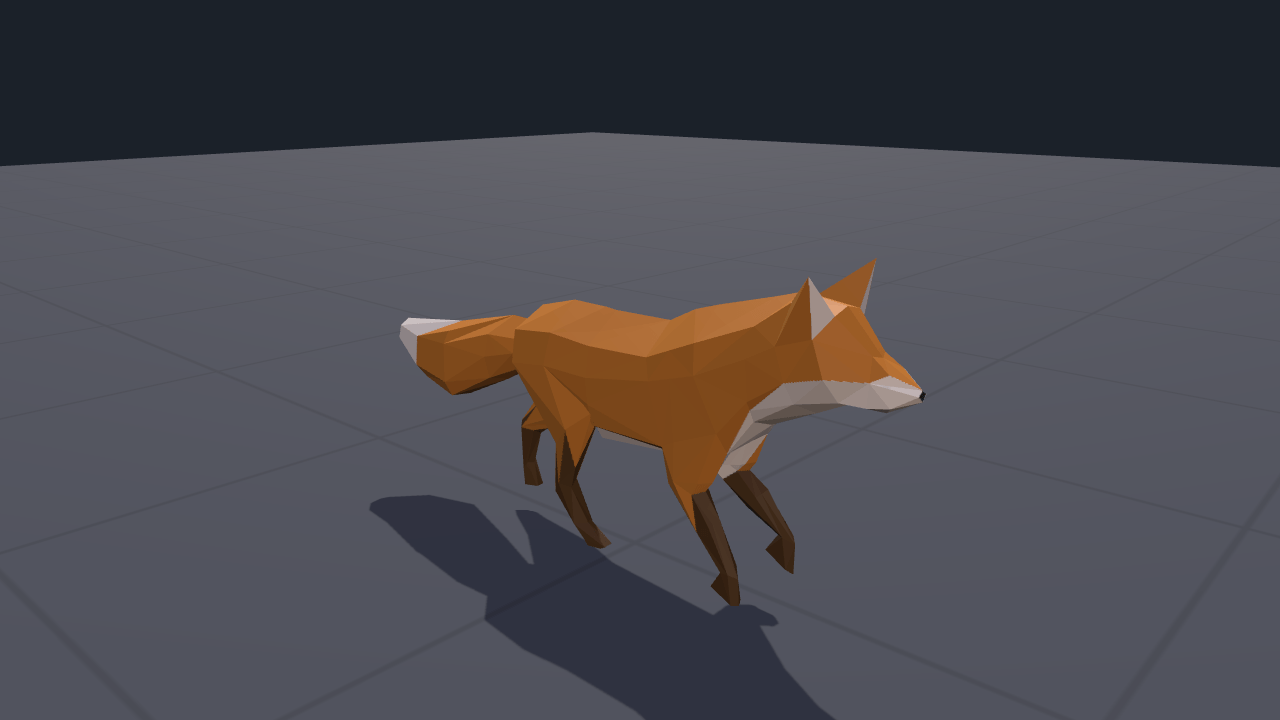
Control a fox with an animation state machine. Changing speed blends its movement clips, while the Survey trigger plays a look-around animation. The panel shows the current state and counts animation events as they fire.
Off airLivePaused
Animator
Gameplay · 3D
WebGPU: checking…See browser support
Try this
- Drag speed from 0 to 8 and watch the Gait readout name the two clips being mixed at each value.
- Press survey: the State readout changes, both events fire, and the exit time returns the fox to its gait.
- Set Rate to 0.25x and press survey again to watch the events in slow motion.
Show source code
Source
import { ANIMATOR_ASSET_TYPE, Animator, Camera, MODEL_ASSET_TYPE, Model, physics, threeD } from "ignifx";import { bootExample } from "../_kit/boot.ts";import { percent } from "../_kit/format.ts";import { attachOrbit } from "../_kit/orbit.ts";import { bind, button, readout, slider } from "../_kit/panel.ts";import { createGridGround, createLightRig } from "../_kit/stage.ts";// The document sits in this example's own directory rather than under `assets/`, so it is not in// the plugin's manifest. `?url` makes Vite emit and hash it like any other asset and hand back its// path; resolving that against this module's own URL is what turns it into the absolute address// `app.assets.load` needs, in dev and in the built site alike.import machineUrl from "./fox.animator.json?url";import type { AnimatorAsset, ModelAsset } from "ignifx";/** * An `Animator`: one `.animator.json` document, one rigged model, and the four things a state * machine is for. `fox.animator.json` next to this file is the whole behaviour and is worth * reading first. It declares a **1D blend tree** on a `speed` parameter — `Survey` at 0, `Walk` at * 2, `Run` at 6, so a value of 4 plays half of each and the gait follows the number rather than * snapping at a threshold; a **trigger** that cuts to a one-shot `survey` state from wherever the * machine is; two **animation events** on that state, which arrive on `Animator.onEvent` as the * clip crosses them; and an **exit time**, which returns the fox to its locomotion nine tenths of * the way through. The code writes one parameter and sets one trigger; the rest is data. * * `Survey` is named twice on purpose: the Fox ships three clips and that one is both the idle and * the look-around, so it is the blend tree's low end *and* a state of its own with `loop: false` * and events on it. The fox runs on the spot for the same kind of reason — the parameter is the * subject, and `third-person` is where a controller writes it from a character's real speed. *//** The metres one of the Fox's authoring units becomes: it is modelled in centimetres. */const FOX_SCALE = 0.009;/** How tall the scaled fox is, in metres: its 79.03-unit bind pose times {@link FOX_SCALE}. */const FOX_HEIGHT = 0.71;/** * The `speed` value the page opens on: between `Walk` and `Run`, so the blend is doing something. * * @remarks * The number the **document** declares, and the panel opens the slider there to match. A start * value belongs in the document, because an `Animator` builds its state machine on its first * advance and a `setFloat` before the first frame has nothing to write to. */const START_SPEED = 4;/** The address of the Khronos Fox. */const FOX_ADDRESS = "models/fox.glb";/** * Where Havok's WebAssembly is served from. `threeD()` requires `physics()`, and the manifest has no * entry for an extension's own file, so the default `"auto"` would look for it next to the run page. */const HAVOK_WASM_URL = `${import.meta.env.BASE_URL}assets/HavokPhysics.wasm`;/** How many recent event names the readout shows. */const EVENT_HISTORY = 3;/** * How far into the locomotion cycle the fox starts, in seconds. * * @remarks * A clip's first frame is rarely its best; this one opens with the fox almost square. `Animator` * writes the pose from its layer's own cursor every frame, so advancing the machine once starts * the fox mid-stride on the first frame, live and in a `?static=1` capture alike. */const START_PHASE = 0.38;bootExample({ title: "Animator", // `threeD()` requires `physics()` and `input()` before it; the kit registers `input()` first. extensions: [physics(), threeD()], settings: { rendering: { clearColor: { r: 0.36, g: 0.395, b: 0.44, a: 1 }, features: { shadows: true }, }, physics: { havokWasm: HAVOK_WASM_URL }, }, async setup({ app, panel, afterStart }) { const eye = app.world.createEntity("Main Camera"); eye.addComponent(Camera, { near: 0.05, far: 100, fov: 40 }); attachOrbit(app, eye, { yaw: 132, pitch: 16, distance: 2.1, target: { x: 0, y: FOX_HEIGHT * 0.6, z: 0 }, minDistance: 1, maxDistance: 10, }); // Both handles are awaited before `app.start()`, where a completed load settles at once. const model = app.assets.load<ModelAsset>(FOX_ADDRESS, { type: MODEL_ASSET_TYPE }); const machineAddress = new URL(machineUrl, import.meta.url).href; const machine = app.assets.load<AnimatorAsset>(machineAddress, { type: ANIMATOR_ASSET_TYPE }); await createGridGround(app, { fade: true }); await Promise.all([model.promise, machine.promise]); createLightRig(app, { focus: { x: 0, y: FOX_HEIGHT / 2, z: 0 }, keyPosition: { x: -2.4, y: 3.4, z: -2 }, shadowDarkness: 0.3, }); const fox = app.world.createEntity("Fox"); fox.transform.localScale.set(FOX_SCALE, FOX_SCALE, FOX_SCALE); fox.addComponent(Model, { model, castShadows: true, receiveShadows: true }); // One `Animator` per **model asset**: Lite binds an animation group to a single manager, so a // second animator over one `.glb` is refused the clips. A second fox needs a second address. const animator = fox.addComponent(Animator, { animator: machine }); // `onEvent` fires once per crossing, in the frame the clip passes the event's time; `owner` // scopes the connection so it disconnects when the animator does. const seen: string[] = []; let total = 0; animator.onEvent.connect( (name: string): void => { total += 1; seen.unshift(name); seen.length = Math.min(seen.length, EVENT_HISTORY); app.log.info("animation event:", name); }, { owner: animator }, ); // The machine exists from the animator's first advance, which `app.start()` has just run. afterStart((): void => { animator.stateMachine?.advance(START_PHASE); }); // One number drives the whole tree: the document decides which clips it mixes, and in what // proportion, from this one parameter. const setSpeed = (value: number): void => { animator.setFloat("speed", value); }; panel({ title: "Animator", groups: [ { label: "Blend tree", controls: [ slider("speed", { min: 0, max: 8, step: 0.1 }, { value: START_SPEED, change: setSpeed }), readout("Gait", (): string => gaitFor(animator.getFloat("speed"))), slider("Rate", { min: 0.1, max: 2, step: 0.05, format: times }, bind(animator, "speed")), ], }, { label: "Trigger", controls: [ // A trigger is consumed by the first transition that reads it, so one press is one // look-around however long the frame took. button("survey", (): void => { animator.setTrigger("survey"); }), readout("State", (): string => animator.currentState()), readout("Clip time", (): string => percent(animator.normalizedTime())), ], }, { label: "Animation events", controls: [ readout("Fired", (): string => String(total)), readout("Recent", (): string => (seen.length === 0 ? "none yet" : seen.join(", "))), ], }, { label: "Frame", collapsed: true, controls: [readout("Draw calls", (): string => String(app.renderer.drawCalls))], }, ], }); },});/** * Names the clips a `speed` value is mixing, so the readout says what the number means. * * @param speed - The `speed` parameter. * @returns The pair being blended, or the single clip at a threshold. */function gaitFor(speed: number): string { if (speed < 2) { return speed <= 0 ? "Survey" : "Survey + Walk"; } return speed === 2 ? "Walk" : speed < 6 ? "Walk + Run" : "Run";}/** * Writes a playback multiplier. * * @param value - The multiplier. * @returns The text for the slider's value cell. */function times(value: number): string { return `${value.toFixed(2)}x`;}{ "format": "ignifx.animator", "formatVersion": 1, "parameters": [ { "name": "speed", "kind": "float", "value": 4 }, { "name": "survey", "kind": "trigger" } ], "layers": [{ "name": "Base", "weight": 1, "defaultState": "locomotion" }], "states": [ { "name": "locomotion", "blendTree": "locomotion", "loop": true }, { "name": "survey", "clip": "Survey", "loop": false, "events": [ { "time": 0.3, "name": "look-up" }, { "time": 0.75, "name": "sniff" } ] } ], "transitions": [ { "from": "any", "to": "survey", "conditions": [{ "param": "survey", "op": "trigger" }], "duration": 0.12 }, { "from": "survey", "to": "locomotion", "duration": 0.25, "exitTime": 0.9 } ], "blendTrees1D": [ { "name": "locomotion", "param": "speed", "children": [ { "clip": "Survey", "threshold": 0 }, { "clip": "Walk", "threshold": 2 }, { "clip": "Run", "threshold": 6 } ] } ]}