All examples
Top-down 2D game
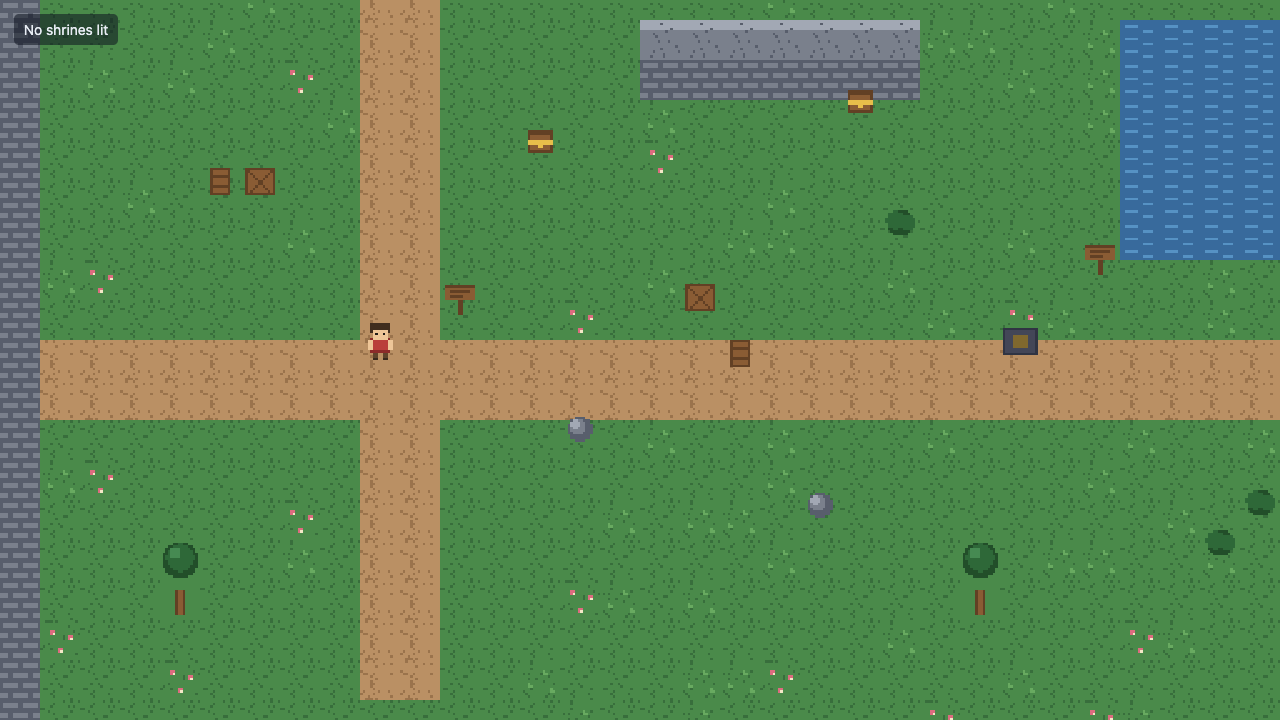
A playable starting point for a top-down game. Explore the courtyard and light shrines to save your progress. The template includes a following camera, collisions, menus, settings and control rebinding.
Off airLivePaused
Top-down 2D game
Templates · 2D
WebGPU: checking…See browser support
Try this
- Walk onto a shrine pad with WASD or the arrows to light it; the game autosaves when you do. Press E to see what is within reach.
- Press Escape for the pause menu, then Settings to move the audio and render-scale sliders.
- Open Settings, then Rebind controls, and give a key a new binding — the override persists across a reload.
Show source code
Source
// oxlint-disable no-underscore-dangle -- `window.__ignifxReady` is a test hook, and the double// underscore is what says it is not part of the game's API. The visual suite reads it by name.import { Camera2D, Camera2DFollow, spawnTilemapObjects, SPRITE_ANIMATION_ASSET_TYPE, SPRITE_ATLAS_ASSET_TYPE, SpriteAnimator, SpriteRenderer, Tilemap, TILEMAP_ASSET_TYPE, TilemapRenderer, twoD,} from "@ignifx/2d";import { audio, AUDIO_ASSET_TYPE, AUDIO_BUSES_ASSET_TYPE, AudioListener, AudioSource } from "@ignifx/audio";import { createApp, isIgnifxError, Vec2 } from "@ignifx/core";import { electron } from "@ignifx/electron";import { INPUT_ACTIONS_ASSET_TYPE, input } from "@ignifx/input";import { BoxCollider2D, CharacterController2D, physics2d, TilemapCollider2D } from "@ignifx/physics-2d";import { I18N_ASSET_TYPE, ui } from "@ignifx/ui";// Vite virtual modules the plugin serves, typed by `@ignifx/vite-plugin/client`.import { manifest } from "virtual:ignifx/manifest";import { acceptHotReload, scripts } from "virtual:ignifx/scripts";import { installFrameTimeProbe } from "./frame-time-probe.js";import { createGameUi, hasTouch } from "./game-ui.js";import { installGameplayProbe } from "./gameplay-probe.js";import { createGameMenus } from "./menus/game-menus.js";import { applySettings, loadInputOverrides, loadSettings } from "./menus/settings-store.js";import { createRun } from "./run.js";import { HudLine } from "./scripts/hud-line.js";import { MenuController } from "./scripts/menu-controller.js";import { PlayerController } from "./scripts/player-controller.js";import { SaveGame } from "./scripts/save-game.js";import { Shrine } from "./scripts/shrine.js";import type { GameMenus } from "./menus/game-menus.js";import type { GraphicsHooks } from "./menus/settings-store.js";import type { Run } from "./run.js";import type { SpriteAnimationAsset, SpriteAtlasAsset, TileObjectContext, TilemapAsset } from "@ignifx/2d";import type { AudioBusesAsset, AudioClip } from "@ignifx/audio";import type { App, AssetHandle, Entity } from "@ignifx/core";import type { InputActionsAsset } from "@ignifx/input";import type { LocaleAsset } from "@ignifx/ui";/** * A top-down 2D game: a tilemap with a collision layer, a Y-sorted layer of props and a character, * a dead-zoned camera follow, shrines to light, a title screen, a pause menu, a settings screen * with interactive rebinding, and a save file. * * The shape of this file is the shape of every ignifx game: * * 1. `createApp` with the extensions the game uses; `ignifx.config.ts` carries the settings. * 2. Load every asset and **await it before `app.start()`**. A load awaited before the loop runs * settles as soon as it finishes; once the loop is running, delivery waits for a `PreUpdate`, * so awaiting after `start()` needs frames to be pumped. * 3. Build the world. * 4. `app.start()`. * * ## Query flags * * - `?static=1` stops the clock before the first frame and leaves the front end out, so the picture * is exactly the authored scene and nothing depends on how long a frame took. It is what the * visual golden suite in `tests/visual/` opens. * - `?hud=1` keeps the DOM overlay visible in a `?static=1` scene, which is what the gallery * capture script uses; a golden leaves it off so the image never depends on how the runner draws * a system font. * - `?probe=1` installs `window.__ignifxGameplay`, the read-only test hook the gameplay half of * `tests/visual/tests/templates.spec.ts` measures the character with. See `src/gameplay-probe.ts`. * - `?locale=<tag>` picks a locale from `assets/strings.i18n.json` before the menus are built. */declare global { interface Window { /** Resolves once the game has presented a settled frame. See the module comment. */ __ignifxReady: Promise<AppStatus>; }}/** What `window.__ignifxReady` resolves to. */type AppStatus = "ready" | "unsupported";/** How many animation frames the scene is given before the image is called settled. */const SETTLE_FRAMES = 12;/** Half the viewport height, in metres: 18 metres of world, which is 288 tile pixels. */const CAMERA_HALF_HEIGHT = 9;/** The map is 40 by 24 cells of one metre, and the camera may not leave it. */const LEVEL_SIZE = { x: 40, y: 24 };/** Explicit loader types for the template assets. */const ATLAS = { type: SPRITE_ATLAS_ASSET_TYPE } as const;const CLIPS = { type: SPRITE_ANIMATION_ASSET_TYPE } as const;const MAP = { type: TILEMAP_ASSET_TYPE } as const;const ACTIONS = { type: INPUT_ACTIONS_ASSET_TYPE } as const;const CLIP = { type: AUDIO_ASSET_TYPE } as const;const BUSES = { type: AUDIO_BUSES_ASSET_TYPE } as const;const STRINGS = { type: I18N_ASSET_TYPE } as const;/** Everything the world is built from. */interface Assets { readonly tiles: AssetHandle<SpriteAtlasAsset>; readonly heroAtlas: AssetHandle<SpriteAtlasAsset>; readonly heroClips: AssetHandle<SpriteAnimationAsset>; readonly level: AssetHandle<TilemapAsset>; readonly pickup: AssetHandle<AudioClip>; readonly footstep: AssetHandle<AudioClip>; readonly uiClick: AssetHandle<AudioClip>; readonly uiHover: AssetHandle<AudioClip>; readonly ambient: AssetHandle<AudioClip>;}/** What {@link buildWorld} produced. */interface World { /** The character. */ readonly player: Entity; /** The camera that follows it. */ readonly camera: Entity; /** Where the character starts. */ readonly spawn: Vec2; /** Every shrine the objects layer spawned. */ readonly shrines: readonly Shrine[];}function noop(): void { // Nothing to do: the promise executor runs synchronously and replaces this on the next line.}let announceReady: (status: AppStatus) => void = noop;window.__ignifxReady = new Promise<AppStatus>((resolve) => { announceReady = resolve;});function nextFrame(): Promise<void> { return new Promise<void>((resolve) => { requestAnimationFrame(() => { resolve(); }); });}/** * Waits for several animation frames, so a newly built scene has presented. * * @param frames - How many frames to wait for. * @returns A promise that resolves after the last of them. */function settle(frames: number): Promise<void> { let chain = Promise.resolve(); for (let index = 0; index < frames; index += 1) { chain = chain.then(nextFrame); } return chain;}/** * The clip behind a handle, or `null` when the browser refused to decode it. * * @remarks * `AssetHandle.value` is only meaningful once the handle is `"loaded"`; every sound in this * template is optional, so a failed decode costs the game that sound and nothing else. * * @param handle - The handle to read. * @returns The clip, or `null`. */function clipOrNull(handle: AssetHandle<AudioClip>): AudioClip | null { return handle.state === "loaded" ? handle.value : null;}/** Swaps the canvas for the "no WebGPU here" panel in `index.html`. */function showUnsupported(): void { document.body.dataset["webgpu"] = "unavailable";}/** * Registers the factories the tilemap's objects layer names, so a map edit can add a prop or move * the spawn point without touching this file. * * @param app - The running app. * @param assets - The loaded assets the factories draw from. * @param shrines - The list every spawned shrine is appended to. * @returns The player entity and its spawn point once the map has been walked. */function registerObjectFactories( app: App, assets: Assets, shrines: Shrine[],): () => { readonly player: Entity | null; readonly spawn: Vec2 } { let player: Entity | null = null; let spawn = new Vec2(); const solid = app.world.layers.requireIndex("Solid"); const triggerLayer = app.world.layers.requireIndex("Trigger"); const atlas = assets.tiles.value; app.twoD.registerTileObjectFactory("spawn", (context: TileObjectContext): Entity => { const entity = app.world.createEntity(context.name); entity.layer = app.world.layers.requireIndex("Player"); spawn = new Vec2(context.position.x, context.position.y); entity.transform.position2D = new Vec2(spawn.x, spawn.y); entity.addComponent(SpriteRenderer, { sprite: assets.heroAtlas, sortingLayer: "Default", pickable: true, }); entity.addComponent(SpriteAnimator, { animations: assets.heroClips, defaultClip: "idle_down", playOnAwake: true, }); // A box, not the default capsule: a top-down character slides along walls more predictably // with square corners, and the shape is what `stepOffset` would need anyway. The offset lifts // the box off the entity's origin, which sits at the sprite's feet. entity.addComponent(CharacterController2D, { shape: "box", radius: 0.3, height: 0.6, offset: { x: 0, y: 0.3 }, slopeLimit: 90, snapToGround: 0, }); const controller = entity.addComponent(PlayerController, { speed: 4.5 }); // The clip is handed over rather than loaded inside the script, so a script that is hot-reloaded // does not re-request a file the asset service has already delivered. if (clipOrNull(assets.footstep) !== null) { controller.footstep = assets.footstep; } player = entity; return entity; }); app.twoD.registerTileObjectFactory("prop", (context: TileObjectContext): Entity => { const entity = app.world.createEntity(context.name); entity.layer = solid; entity.transform.position2D = new Vec2(context.position.x, context.position.y); const frame = String(context.properties["frame"] ?? "crate"); entity.addComponent(SpriteRenderer, { sprite: assets.tiles, sortingLayer: "Default", pickable: true, // `frame` is a runtime property rather than a schema field, so it is assigned after the // component exists; passing it to `addComponent` is `IGX-0607`. }).frame = atlas.requireFrame(frame); // The collider is shorter than the sprite: only the base of a prop blocks a character, which // is what makes a Y-sorted scene feel like it has depth rather than like a wall of boxes. entity.addComponent(BoxCollider2D, { size: { x: 0.9, y: 0.5 }, offset: { x: 0, y: 0.25 } }); return entity; }); app.twoD.registerTileObjectFactory("shrine", (context: TileObjectContext): Entity => { const entity = app.world.createEntity(context.name); entity.layer = triggerLayer; entity.transform.position2D = new Vec2(context.position.x, context.position.y); entity.addComponent(SpriteRenderer, { sprite: assets.tiles, sortingLayer: "Decal", }).frame = atlas.requireFrame(String(context.properties["frame"] ?? "pad")); entity.addComponent(BoxCollider2D, { size: { x: context.size.x, y: context.size.y }, offset: { x: 0, y: context.size.y / 2 }, isTrigger: true, }); const shrine = entity.addComponent(Shrine); if (clipOrNull(assets.pickup) !== null) { shrine.clip = assets.pickup; } shrines.push(shrine); return entity; }); return () => ({ player, spawn });}/** * Builds the world: the tilemap and its collider, everything the objects layer spawns, and the * camera that follows whatever the `spawn` object produced. * * @param app - The running app. * @param assets - The loaded assets. * @returns The character, its spawn point and the shrines. */function buildWorld(app: App, assets: Assets): World { const shrines: Shrine[] = []; const take = registerObjectFactories(app, assets, shrines); const level = app.world.createEntity("Level"); level.layer = app.world.layers.requireIndex("Solid"); const map = level.addComponent(Tilemap, { map: assets.level, chunkSize: 16 }); level.addComponent(TilemapRenderer, { atlas: assets.tiles, cullChunks: true }); // The merged outlines of every solid tile, as one static compound body. `TilemapCollider2D` // watches the data's `version` each fixed step, so editing a tile at runtime reaches physics // with no subscription of our own. level.addComponent(TilemapCollider2D).collisionData = map.collisionData; // Objects are normally spawned by the extension when a *scene file* finishes loading. This // template builds its world in code, so it walks the objects layer itself. spawnTilemapObjects(app, app.twoD, map); const spawned = take(); if (spawned.player === null) { throw new Error('level.tilemap.json has no object of type "spawn".'); } const eye = app.world.createEntity("Main Camera"); eye.transform.position2D = new Vec2(spawned.spawn.x, spawned.spawn.y); eye.addComponent(Camera2D, { orthographicSize: CAMERA_HALF_HEIGHT, follow: spawned.player, followDamping: 0.12, // The target rides the edge of this rectangle instead of being pinned to the middle of the // screen, so small steps do not drag the whole world around. deadZone: { x: 1.5, y: 1 }, boundsMin: { x: 0, y: 0 }, boundsMax: LEVEL_SIZE, }); eye.addComponent(Camera2DFollow); // The ears ride the camera, so a sound is panned from where the player is looking. eye.addComponent(AudioListener); return { player: spawned.player, camera: eye, spawn: spawned.spawn, shrines };}/** * Builds the front end and the save file over a world that is already standing. * * @param app - The running app. * @param assets - The loaded assets. * @param world - What {@link buildWorld} produced. * @param hud - The HUD element, or `null` under an app with no DOM overlay. * @param isBench - Whether the frame-time harness is driving, in which case the game starts * immediately instead of waiting on a title screen. * @returns A promise that answers with the run once the front end is up. */async function installFrontEnd( app: App, assets: Assets, world: World, hud: HTMLDivElement | null, isBench: boolean,): Promise<Run> { // A 2D sprite scene has no shadow-casting light and no post-process chain, so the settings // screen leaves both graphics rows out rather than offering a switch that does nothing. const graphics: GraphicsHooks = { supportsShadows: false, supportsPostProcessing: false, setShadows: (): void => { // No shadows in a sprite scene. }, setPostProcessing: (): void => { // No post-process chain in a sprite scene. }, }; await loadInputOverrides(app); const settings = await loadSettings(app, app.i18n.locale); applySettings(app, settings, graphics); const host = app.world.createEntity("Game UI"); const saveGame = host.addComponent(SaveGame); let menus: GameMenus | null = null; const run = createRun(world.player, world.shrines, world.spawn, (): void => { if (saveGame.checkpoint()) { menus?.toast(app.i18n.t("toast.checkpoint")); } }); saveGame.run = run.state; menus = createGameMenus(app, { settings, graphics, gameplayMap: "Player", rebindable: [ { action: "interact", labelKey: "action.interact" }, { action: "pause", labelKey: "action.pause" }, ], creditKeys: ["credits.engine", "credits.art", "credits.license"], sounds: { click: clipOrNull(assets.uiClick), hover: clipOrNull(assets.uiHover) }, onStartNew: (): void => { saveGame.restart(); }, onContinue: (save): void => { saveGame.restore(save); }, onSaveNow: (): Promise<boolean> => saveGame.save(), onQuitToTitle: (): void => { saveGame.restart(); }, }); host.addComponent(MenuController).menus = menus; const line = host.addComponent(HudLine); line.element = hud; line.render = (): string => app.i18n.t("hud.status", { score: run.score() }); // `interact` runs a shape query and now says what it found, because a control the player is told // to press has to do something the player can see. const controller = world.player.getComponent(PlayerController); if (controller !== null) { controller.onLookAround = (names: readonly string[]): void => { menus.toast( names.length === 0 ? app.i18n.t("toast.nothingNearby") : app.i18n.t("toast.nearby", { names: names.join(", ") }), ); }; } // The ambient pad loops on the `Music` bus, which `game.audio.json` marks as not pausable so the // menus can duck it rather than silence it. if (clipOrNull(assets.ambient) !== null) { app.world.createEntity("Ambience").addComponent(AudioSource, { clip: assets.ambient, bus: "Music", loop: true, playOnAwake: true, volume: 0.9, }); } if (isBench) { // The frame-time harness measures a *running* game, so it skips the title screen. Everything // else is the scene a player gets. return run; } // The game boots into its title screen. `MenuController` reconciles `app.pause()` against the // screen stack every frame, so this one call is what stops the world until "New game". menus.show("title"); app.pause(); return run;}async function main(): Promise<AppStatus> { const canvas = document.querySelector("#game"); if (!(canvas instanceof HTMLCanvasElement)) { throw new Error('2d-topdown needs a <canvas id="game"> element on the page.'); } const flags = new URLSearchParams(window.location.search); const isStatic = flags.get("static") === "1"; const isBench = flags.get("bench") === "1"; const showOverlay = (!isStatic || flags.get("hud") === "1") && !isBench; let app: App; try { app = await createApp({ canvas, settings: import.meta.env.IGNIFX_CONFIG, // The address-to-URL table `@ignifx/vite-plugin` built from `assets/`. Importing the virtual // module rather than fetching `assets.manifest.json` means the table is in the bundle, so // the first asset request needs no round trip. assets: { manifest }, // `electron()` is registered in **both** builds. Without a preload bridge it is inert — one // debug line, and an `app.desktop` that answers `isElectron === false` — so the browser build // is unchanged and the desktop build needs no second entry point. It goes first because it // only requires core, and because `app.storage` should be the file backend before any other // extension reads a setting from it. extensions: [electron(), twoD(), physics2d(), input(), audio(), ui()], }); } catch (error) { // IGX-0701 is the one failure a shipped game must handle itself: the browser has no WebGPU and // ignifx has no fallback renderer by decision (ADR-0001). if (isIgnifxError(error) && error.code === "IGX-0701") { showUnsupported(); return "unsupported"; } throw error; } // Every class under `src/scripts/**` with a `static typeId`, from the plugin's virtual registry; in // development the registry hot-reloads edited scripts through `app.hotReload` (`"patch"` by default). app.registerComponents(scripts); acceptHotReload(app); // The strings come first and alone: every label below is read out of them, and the document is // under three kilobytes, so nothing is gained by making the loading screen wait for it. const strings = app.assets.load<LocaleAsset>("strings.i18n.json", STRINGS); await strings.promise; await app.i18n.load(strings); const locale = flags.get("locale"); if (locale !== null && app.i18n.availableLocales.includes(locale)) { app.i18n.locale = locale; } // The overlay comes up before the first asset is requested, so the loading bar sees every byte. const gameUi = createGameUi(app, { loadingLabel: app.i18n.t("loading.label"), buttons: [{ control: "interact", label: "E", ariaLabel: app.i18n.t("action.interact") }], moveLabel: app.i18n.t("action.move"), pauseLabel: app.i18n.t("action.pause"), touch: !isStatic && hasTouch(), }); app.ui.visible = showOverlay; const assets: Assets = { tiles: app.assets.load<SpriteAtlasAsset>("tiles.atlas.json", ATLAS), heroAtlas: app.assets.load<SpriteAtlasAsset>("hero.atlas.json", ATLAS), heroClips: app.assets.load<SpriteAnimationAsset>("hero.spriteanim.json", CLIPS), level: app.assets.load<TilemapAsset>("level.tilemap.json", MAP), pickup: app.assets.load<AudioClip>("pickup.wav", CLIP), footstep: app.assets.load<AudioClip>("footstep.wav", CLIP), uiClick: app.assets.load<AudioClip>("ui-click.wav", CLIP), uiHover: app.assets.load<AudioClip>("ui-hover.wav", CLIP), ambient: app.assets.load<AudioClip>("ambient.wav", CLIP), }; const actions = app.assets.load<InputActionsAsset>("game.input.json", ACTIONS); const buses = app.assets.load<AudioBusesAsset>("game.audio.json", BUSES); await Promise.all([ assets.tiles.promise, assets.heroAtlas.promise, assets.heroClips.promise, assets.level.promise, actions.promise, buses.promise, ]); // The clips are awaited together and separately from the rest: a browser that refuses to decode // a sound should cost the game its audio, not its first frame. await Promise.all( [assets.pickup, assets.footstep, assets.uiClick, assets.uiHover, assets.ambient].map( async (handle: AssetHandle<AudioClip>): Promise<void> => { await handle.promise.catch((error: unknown) => { app.log.warn("a sound could not be decoded: {error}", String(error)); }); }, ), ); // Installed here rather than through `input.actions` in `ignifx.config.ts`, so that the maps // exist before the first `update` runs. See the comment in that file. app.input.loadActions(actions.value); await app.audio.buildBuses(buses.value.buses); const world = buildWorld(app, assets); if (isStatic) { // Stopping the clock *before* `start()` means no fixed step ever runs, so nothing falls, // nothing animates and the camera never chases: the frame is exactly what was authored. The // front end is left out for the same reason. app.time.timeScale = 0; } else { const run = await installFrontEnd(app, assets, world, gameUi.hud, isBench); // A read-only test hook, and only under `?probe=1`: the gameplay half of the template spec // measures the character in metres rather than in pixels. See `src/gameplay-probe.ts`. if (flags.get("probe") === "1") { installGameplayProbe(app, world.player, world.camera, world.shrines, run); } } if (isStatic && showOverlay && gameUi.hud !== null) { // `?static=1` leaves the front end out, so nothing writes the HUD. `?hud=1` says the overlay is // wanted anyway — the gallery capture asks for exactly that — so the zero state is written once. gameUi.hud.textContent = app.i18n.t("hud.status", { score: 0 }); } gameUi.loading.hide(); if (isBench) { installFrameTimeProbe(app); } await app.start(); await settle(SETTLE_FRAMES); app.log.info("2d-topdown running; sprites:", app.twoD.spriteCount); return "ready";}void main().then(announceReady, (error: unknown) => { showUnsupported(); announceReady("unsupported"); // Rethrown out of the promise chain so it reaches `window.onerror` as an uncaught error rather // than a swallowed rejection. Templates never log through `console` (coding standards §6). setTimeout(() => { throw error; }, 0);});